


Page 429 - Electrical Properties of Materials
P. 429
Polarizability of a current-carrying resonant loop                 411

                 d c                                                  g
                                                                    w
                   L                                                    d
             D      c                               w                r 2
                      b                             h               r 3  r 1
                                                    f        g        r 4
                 b            s              t         ed c
                 (a)         (b)            (c)         (d)          (e)

                      w  t
                 r                 r
            l                s                                               Fig. 15.6
               g                                                             A variety of small resonators used in
                 (f)          (g)          (h)          (i)          (j)     metamaterials studies.

            average inductance of the two rings equal to L, and the inter-ring capacitance
            per unit length equal to C pu . Then the capacitance of a half-ring is equal to

                                    C half-ring = πr 0 C pu          (15.10)

            and the total capacitance is equal to


                                   1            1
                             C =      C half-ring =  πr 0 C pu ,     (15.11)
                                   2            2
            whence the resonant frequency is

                                                  –1/2
                                        πr 0 LC pu
                                  ω 0 =             .                (15.12)
                                           2
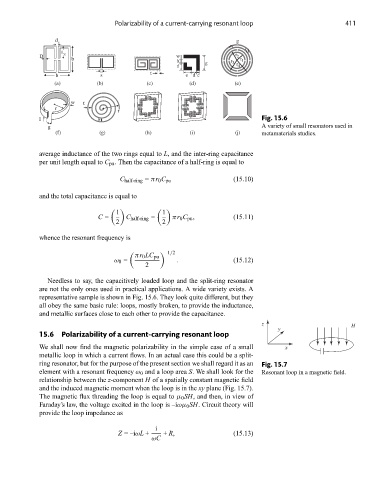
               Needless to say, the capacitively loaded loop and the split-ring resonator
            are not the only ones used in practical applications. A wide variety exists. A
            representative sample is shown in Fig. 15.6. They look quite different, but they
            all obey the same basic rule: loops, mostly broken, to provide the inductance,
            and metallic surfaces close to each other to provide the capacitance.
                                                                             z                         H
                                                                                  y
            15.6 Polarizability of a current-carrying resonant loop
            We shall now find the magnetic polarizability in the simple case of a small  x
            metallic loop in which a current flows. In an actual case this could be a split-
            ring resonator, but for the purpose of the present section we shall regard it as an  Fig. 15.7
            element with a resonant frequency ω 0 and a loop area S. We shall look for the  Resonant loop in a magnetic field.
            relationship between the z-component H of a spatially constant magnetic field
            and the induced magnetic moment when the loop is in the xy plane (Fig. 15.7).
            The magnetic flux threading the loop is equal to μ 0 SH, and then, in view of
            Faraday’s law, the voltage excited in the loop is –iωμ 0 SH. Circuit theory will
            provide the loop impedance as

                                              i
                                   Z =–iωL +    + R,                 (15.13)
                                             ωC

