


Page 433 - Electrical Properties of Materials
P. 433
Effect of negative material constants                   415


                           0
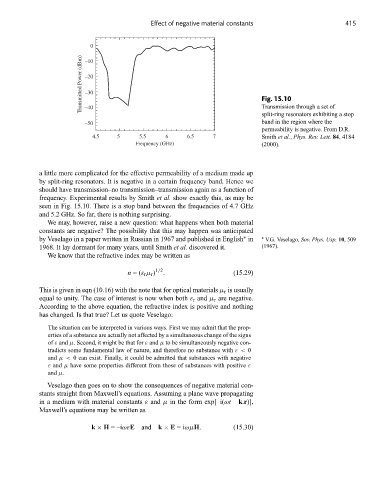
                         Transmitted Power (dBm)  –20                        Fig. 15.10
                          –10


                          –30

                                                                             Transmission through a set of
                          –40
                                                                             split-ring resonators exhibiting a stop
                          –50                                                band in the region where the
                                                                             permeability is negative. From D.R.
                            4.5    5     5.5     6     6.5     7             Smith et al., Phys. Rev. Lett. 84, 4184
                                        Frequency (GHz)                      (2000).


            a little more complicated for the effective permeability of a medium made up
            by split-ring resonators. It is negative in a certain frequency band. Hence we
            should have transmission–no transmission–transmission again as a function of
            frequency. Experimental results by Smith et al. show exactly this, as may be
            seen in Fig. 15.10. There is a stop band between the frequencies of 4.7 GHz
            and 5.2 GHz. So far, there is nothing surprising.
               We may, however, raise a new question: what happens when both material
            constants are negative? The possibility that this may happen was anticipated
            by Veselago in a paper written in Russian in 1967 and published in English in  ∗  V.G. Veselago, Sov. Phys. Usp. 10, 509
                                                                        ∗
            1968. It lay dormant for many years, until Smith et al. discovered it.  (1967).
               We know that the refractive index may be written as

                                      n =(ε r μ r ) 1/2 .            (15.29)

            This is given in eqn (10.16) with the note that for optical materials μ r is usually
            equal to unity. The case of interest is now when both ε r and μ r are negative.
            According to the above equation, the refractive index is positive and nothing
            has changed. Is that true? Let us quote Veselago:
               The situation can be interpreted in various ways. First we may admit that the prop-
               erties of a substance are actually not affected by a simultaneous change of the signs
               of ε and μ. Second, it might be that for ε and μ to be simultaneously negative con-
               tradicts some fundamental law of nature, and therefore no substance with ε< 0
               and μ< 0 can exist. Finally, it could be admitted that substances with negative
               ε and μ have some properties different from those of substances with positive ε
               and μ.
               Veselago then goes on to show the consequences of negative material con-
            stants straight from Maxwell’s equations. Assuming a plane wave propagating
            in a medium with material constants ε and μ in the form exp[–i(ωt – k.r)],
            Maxwell’s equations may be written as

                            k × H =–iωεE  and  k × E =iωμH.          (15.30)

