


Page 438 - Electrical Properties of Materials
P. 438
420                           Artificial materials or metamaterials

             10 2                                       1.6
                                            full        1.4
                                            ES
              1
             10                                         1.2
                                                               full
                                                         1
            |T|  10 0                                 |E x | 2  0.8
                                                        0.6
              –1
             10                                         0.4
                                                        0.2
                                                             ES
             10 –2                                       0
               0       5       10      15      20       –200    –100     0       100     200
                               /k
                              k x  0                                    x [nm]
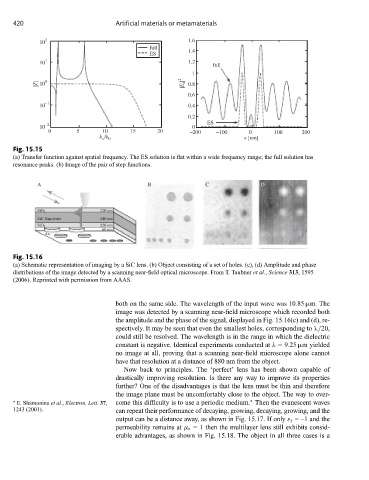
     Fig. 15.15
     (a) Transfer function against spatial frequency. The ES solution is flat within a wide frequency range; the full solution has
     resonance peaks. (b) Image of the pair of step functions.


            A                               B                C               D


            SiO 2             220 nm
            SiC Superlens     440 nm
            SiO 2             220 nm
                               60 nm
              Au

     Fig. 15.16
     (a) Schematic representation of imaging by a SiC lens. (b) Object consisting of a set of holes. (c), (d) Amplitude and phase
     distributions of the image detected by a scanning near-field optical microscope. From T. Taubner et al., Science 313, 1595
     (2006). Reprinted with permission from AAAS.


                                   both on the same side. The wavelength of the input wave was 10.85 μm. The
                                   image was detected by a scanning near-field microscope which recorded both
                                   the amplitude and the phase of the signal, displayed in Fig. 15.16(c) and (d), re-
                                   spectively. It may be seen that even the smallest holes, corresponding to λ/20,
                                   could still be resolved. The wavelength is in the range in which the dielectric
                                   constant is negative. Identical experiments conducted at λ =9.25 μm yielded
                                   no image at all, proving that a scanning near-field microscope alone cannot
                                   have that resolution at a distance of 880 nm from the object.
                                     Now back to principles. The ‘perfect’ lens has been shown capable of
                                   drastically improving resolution. Is there any way to improve its properties
                                   further? One of the disadvantages is that the lens must be thin and therefore
                                   the image plane must be uncomfortably close to the object. The way to over-
                                                                          ∗
     ∗  E. Shamonina et al., Electron. Lett. 37,  come this difficulty is to use a periodic medium. Then the evanescent waves
     1243 (2001).                  can repeat their performance of decaying, growing, decaying, growing, and the
                                   output can be a distance away, as shown in Fig. 15.17. If only ε r = –1 and the
                                   permeability remains at μ r = 1 then the multilayer lens still exhibits consid-
                                   erable advantages, as shown in Fig. 15.18. The object in all three cases is a

