


Page 434 - Electrical Properties of Materials
P. 434
416                           Artificial materials or metamaterials

              n 2  = 0.17          It may be seen from the above equations that it makes a difference whether the
                      n 2  = 0.2
                                   material constants are both positive or both negative. In the former case the
                          n 2  = 0.3  vectors E, H, and k constitute a right-handed set, whereas for negative ε and μ
                                   we have a left-handed set. The wave vector k tells us the direction of the phase
                           n 2  = 1
                                   velocity, and the Poynting vector tells us the direction of the group velocity. If
                                   the two are in opposite directions, we have a backward-wave material with all
                           n 2  = –1
      u 1 =10°                     that that implies. Thus negative refraction at a boundary between two materials,
                          n 2  = –0.3  one having positive material constants and the other negative ones, follows
                                   immediately. But there is an alternative explanation. When one takes the square
                       n 2  = –0.2
                                   root of a positive real quantity, the result may be positive or negative. It is
              n 2  = –0.17         sensible to take it positive when the material constants are both positive and to
                                   take it negative when both material constants are negative. But that will have
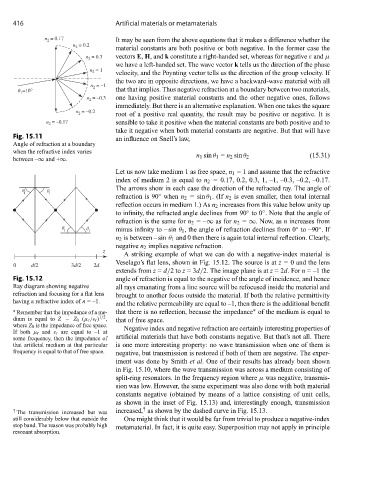
     Fig. 15.11                    an influence on Snell’s law,
     Angle of refraction at a boundary
     when the refractive index varies
                                                          n 1 sin θ 1 = n 2 sin θ 2        (15.31)
     between –∞ and +∞.
                                   Let us now take medium 1 as free space, n 1 = 1 and assume that the refractive
                                   index of medium 2 is equal to n 2 = 0.17, 0.2, 0.3, 1, –1, –0.3, –0.2, –0.17.
       θ       θ                   The arrows show in each case the direction of the refracted ray. The angle of
        1      1
                                   refraction is 90 when n 2 =sin θ 1 .(If n 2 is even smaller, then total internal
                                               ◦
                                   reflection occurs in medium 1.) As n 2 increases from this value below unity up
                                                                         ◦
                                                                             ◦
                                   to infinity, the refracted angle declines from 90 to 0 . Note that the angle of
                                   refraction is the same for n 2 =–∞ as for n 2 = ∞.Now,as n increases from
                   θ      θ                                                            ◦     ◦
                    1      1       minus infinity to – sin θ 1 , the angle of refraction declines from 0 to –90 .If
                                   n 2 is between – sin θ 1 and 0 then there is again total internal reflection. Clearly,
                                   negative n 2 implies negative refraction.
                               z
                                     A striking example of what we can do with a negative-index material is
                                   Veselago’s flat lens, shown in Fig. 15.12. The source is at z = 0 and the lens
     0    d/2         3d/2  2d
                                   extends from z = d/2to z =3d/2. The image plane is at z =2d.For n =–1 the
     Fig. 15.12                    angle of refraction is equal to the negative of the angle of incidence, and hence
     Ray diagram showing negative  all rays emanating from a line source will be refocused inside the material and
     refraction and focusing for a flat lens  brought to another focus outside the material. If both the relative permittivity
     having a refractive index of n = –1.
                                   and the relative permeability are equal to –1, then there is the additional benefit
                                                                          ∗
     ∗  Remember that the impedance of a me-  that there is no reflection, because the impedance of the medium is equal to
     dium is equal to Z = Z 0 (μ r /ε r ) 1/2 ,  that of free space.
     where Z 0 is the impedance of free space.  Negative index and negative refraction are certainly interesting properties of
     If both μ r and ε r are equal to –1 at
     some frequency, then the impedance of  artificial materials that have both constants negative. But that’s not all. There
     that artificial medium at that particular  is one more interesting property: no wave transmission when one of them is
     frequency is equal to that of free space.  negative, but transmission is restored if both of them are negative. The exper-
                                   iment was done by Smith et al. One of their results has already been shown
                                   in Fig. 15.10, where the wave transmission was across a medium consisting of
                                   split-ring resonators. In the frequency region where μ was negative, transmis-
                                   sion was low. However, the same experiment was also done with both material
                                   constants negative (obtained by means of a lattice consisting of unit cells,
                                   as shown in the inset of Fig. 15.13) and, interestingly enough, transmission
                                          †
     †  The transmission increased but was  increased, as shown by the dashed curve in Fig. 15.13.
     still considerably below that outside the  One might think that it would be far from trivial to produce a negative-index
     stop band. The reason was probably high  metamaterial. In fact, it is quite easy. Superposition may not apply in principle
     resonant absorption.

