


Page 430 - Electrical Properties of Materials
P. 430
412                           Artificial materials or metamaterials

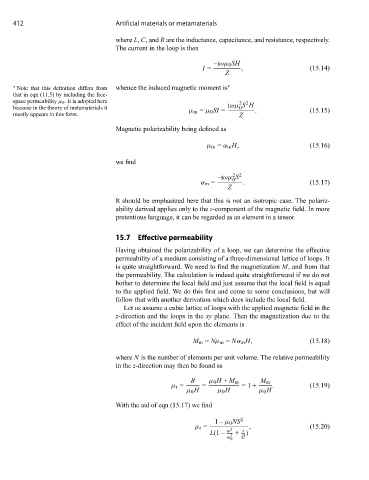
                                   where L, C, and R are the inductance, capacitance, and resistance, respectively.
                                   The current in the loop is then

                                                               –iωμ 0 SH
                                                            I =        ,                   (15.14)
                                                                  Z

     ∗                             whence the induced magnetic moment is ∗
      Note that this definition differs from
     that in eqn (11.5) by including the free-
     space permeability μ 0 . It is adopted here                      2 2
     because in the theory of metamaterials it          μ m = μ 0 SI =  iωμ S H  .         (15.15)
                                                                      0
     mostly appears in this form.                                     Z
                                   Magnetic polarizability being defined as

                                                             μ m = α m H,                  (15.16)

                                   we find
                                                                    2 2
                                                                –iωμ S
                                                                    0
                                                           α m =        .                  (15.17)
                                                                   Z
                                   It should be emphasized here that this is not an isotropic case. The polariz-
                                   ability derived applies only to the z-component of the magnetic field. In more
                                   pretentious language, it can be regarded as an element in a tensor.

                                   15.7  Effective permeability

                                   Having obtained the polarizability of a loop, we can determine the effective
                                   permeability of a medium consisting of a three-dimensional lattice of loops. It
                                   is quite straightforward. We need to find the magnetization M, and from that
                                   the permeability. The calculation is indeed quite straightforward if we do not
                                   bother to determine the local field and just assume that the local field is equal
                                   to the applied field. We do this first and come to some conclusions, but will
                                   follow that with another derivation which does include the local field.
                                     Let us assume a cubic lattice of loops with the applied magnetic field in the
                                   z-direction and the loops in the xy plane. Then the magnetization due to the
                                   effect of the incident field upon the elements is

                                                         M m = Nμ m = Nα m H,              (15.18)

                                   where N is the number of elements per unit volume. The relative permeability
                                   in the z-direction may then be found as
                                                        B     μ 0 H + M m    M m
                                                   μ r =    =          =1 +     .          (15.19)
                                                       μ 0 H    μ 0 H       μ 0 H

                                   With the aid of eqn (15.17) we find

                                                               1– μ 0 NS 2
                                                          μ r =     2    ,                 (15.20)
                                                              L(1 –  ω  +  i  )
                                                                   ω 2  Q
                                                                    0

