


Page 95 - Electrical Properties of Materials
P. 95
Feynman’s coupled mode approach                          77

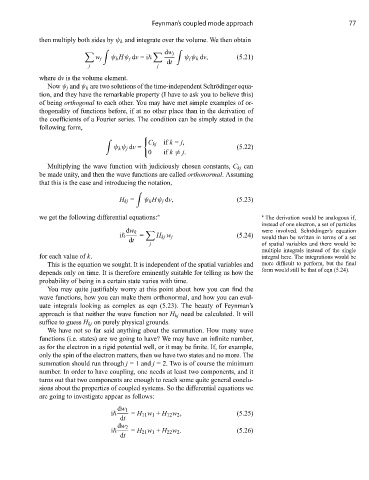
            then multiply both sides by ψ k and integrate over the volume. We then obtain

                                                 dw j

                             w j  ψ k Hψ j dv =i       ψ j ψ k dv,    (5.21)
                                                 dt
                           j                   j
            where dv is the volume element.
               Now ψ j and ψ k are two solutions of the time-independent Schrödinger equa-
            tion, and they have the remarkable property (I have to ask you to believe this)
            of being orthogonal to each other. You may have met simple examples of or-
            thogonality of functions before, if at no other place than in the derivation of
            the coefficients of a Fourier series. The condition can be simply stated in the
            following form,


                                            C kj  if k = j,
                                  ψ k ψ j dv =                        (5.22)
                                            0    if k  = j.
               Multiplying the wave function with judiciously chosen constants, C kj can
            be made unity, and then the wave functions are called orthonormal. Assuming
            that this is the case and introducing the notation,

                                    H kj =  ψ k Hψ j dv,              (5.23)

            we get the following differential equations: ∗                   ∗  The derivation would be analogous if,
                                                                             instead of one electron, a set of particles
                                      dw k                                   were involved. Schrödinger’s equation
                                    i     =   H kj w j                (5.24)  would then be written in terms of a set
                                      dt
                                            j                                of spatial variables and there would be
                                                                             multiple integrals instead of the single
            for each value of k.                                             integral here. The integrations would be
               This is the equation we sought. It is independent of the spatial variables and  more difficult to perform, but the final
                                                                             form would still be that of eqn (5.24).
            depends only on time. It is therefore eminently suitable for telling us how the
            probability of being in a certain state varies with time.
               You may quite justifiably worry at this point about how you can find the
            wave functions, how you can make them orthonormal, and how you can eval-
            uate integrals looking as complex as eqn (5.23). The beauty of Feynman’s
            approach is that neither the wave function nor H kj need be calculated. It will
            suffice to guess H kj on purely physical grounds.
               We have not so far said anything about the summation. How many wave
            functions (i.e. states) are we going to have? We may have an infinite number,
            as for the electron in a rigid potential well, or it may be finite. If, for example,
            only the spin of the electron matters, then we have two states and no more. The
            summation should run through j = 1 and j = 2. Two is of course the minimum
            number. In order to have coupling, one needs at least two components, and it
            turns out that two components are enough to reach some quite general conclu-
            sions about the properties of coupled systems. So the differential equations we
            are going to investigate appear as follows:

                                   dw 1
                                 i     = H 11 w 1 + H 12 w 2 ,        (5.25)
                                    dt
                                   dw 2
                                 i     = H 21 w 1 + H 22 w 2 .        (5.26)
                                    dt

