


Page 487 - Electromagnetics
P. 487
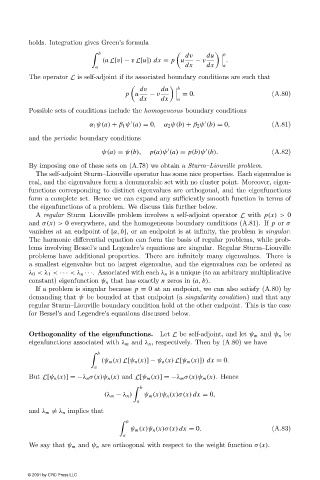
holds. Integration gives Green’s formula
                                             b                        dv    du       b
                                             (u L[v] − v L[u]) dx = p u  − v      .

                                           a                         dx     dx   a
                        The operator L is self-adjoint if its associated boundary conditions are such that

                                                        dv    du
                                                                      b
                                                    p u    − v       = 0.                      (A.80)

                                                        dx    dx   a
                        Possible sets of conditions include the homogeneous boundary conditions
                                          α 1 ψ(a) + β 1 ψ (a) = 0,  α 2 ψ(b) + β 2 ψ (b) = 0,  (A.81)


                        and the periodic boundary conditions
                                             ψ(a) = ψ(b),  p(a)ψ (a) = p(b)ψ (b).              (A.82)


                        By imposing one of these sets on (A.78) we obtain a Sturm–Liouville problem.
                          The self-adjoint Sturm–Liouville operator has some nice properties. Each eigenvalue is
                        real, and the eigenvalues form a denumerable set with no cluster point. Moreover, eigen-
                        functions corresponding to distinct eigenvalues are orthogonal, and the eigenfunctions
                        form a complete set. Hence we can expand any sufficiently smooth function in terms of
                        the eigenfunctions of a problem. We discuss this further below.
                          A regular Sturm–Liouville problem involves a self-adjoint operator L with p(x)> 0
                        and σ(x)> 0 everywhere, and the homogeneous boundary conditions (A.81). If p or σ
                        vanishes at an endpoint of [a, b], or an endpoint is at infinity, the problem is singular.
                        The harmonic differential equation can form the basis of regular problems, while prob-
                        lems involving Bessel’s and Legendre’s equations are singular. Regular Sturm–Liouville
                        problems have additional properties. There are infinitely many eigenvalues. There is
                        a smallest eigenvalue but no largest eigenvalue, and the eigenvalues can be ordered as
                        λ 0 <λ 1 < ··· <λ n ···. Associated with each λ n is a unique (to an arbitrary multiplicative
                        constant) eigenfunction ψ n that has exactly n zeros in (a, b).
                          If a problem is singular because p = 0 at an endpoint, we can also satisfy (A.80) by
                        demanding that ψ be bounded at that endpoint (a singularity condition) and that any
                        regular Sturm–Liouville boundary condition hold at the other endpoint. This is the case
                        for Bessel’s and Legendre’s equations discussed below.


                        Orthogonality of the eigenfunctions.  Let L be self-adjoint, and let ψ m and ψ n be
                        eigenfunctions associated with λ m and λ n , respectively. Then by (A.80) we have
                                             b
                                             (ψ m (x) L[ψ n (x)] − ψ n (x) L[ψ m (x)]) dx = 0.
                                           a
                        But L[ψ n (x)] =−λ n σ(x)ψ n (x) and L[ψ m (x)] =−λ m σ(x)ψ m (x). Hence
                                                        b

                                              (λ m − λ n )  ψ m (x)ψ n (x)σ(x) dx = 0,
                                                       a
                        and λ m  = λ n implies that
                                                     b
                                                     ψ m (x)ψ n (x)σ(x) dx = 0.                (A.83)
                                                   a
                        We say that ψ m and ψ n are orthogonal with respect to the weight function σ(x).


                        © 2001 by CRC Press LLC

