


Page 486 - Electromagnetics
P. 486
A.4    Boundary value problems
                          Many physical phenomena may be described mathematically as the solutions to bound-
                        ary value problems. The desired physical quantity (usually called a “field”) in a certain
                        region of space is found by solving one or more partial differential equations subject to
                        certain conditions over the boundary surface. The boundary conditions may specify the
                        values of the field, some manipulated version of the field (such as the normal derivative),
                        or a relationship between fields in adjoining regions. If the field varies with time as well
                        as space, initial or final values of the field must also be specified. Particularly important
                        is whether a boundary value problem is well-posed and therefore has a unique solution
                        which depends continuously on the data supplied. This depends on the forms of the dif-
                        ferential equation and boundary conditions. The well-posedness of Maxwell’s equations
                        is discussed in § 2.2.
                          The importance of boundary value problems has led to an array of techniques, both
                        analytical and numerical, for solving them. Many problems (such as boundary value
                        problems involving Laplace’s equation) may be solved in several different ways. Unique-
                        ness permits an engineer to focus attention on which technique will yield the most efficient
                        solution. In this section we concentrate on the separation of variables technique, which is
                        widely applied in the solution of Maxwell’s equations. We first discuss eigenvalue prob-
                        lems and then give an overview of separation of variables. Finally we consider a number
                        of example problems in each of the three common coordinate systems.

                        Sturm–Liouville problems and eigenvalues
                          The partial differential equations of electromagnetics can often be reduced to ordinary
                        differential equations. In some cases symmetry permits us to reduce the number of
                        dimensions by inspection; in other cases, we may employ an integral transform (e.g.,
                        the Fourier transform) or separation of variables. The resulting ordinary differential
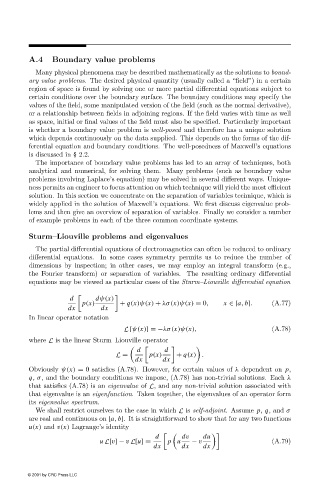
                        equations may be viewed as particular cases of the Sturm–Liouville differential equation


                                    d      dψ(x)
                                       p(x)       + q(x)ψ(x) + λσ(x)ψ(x) = 0,    x ∈ [a, b].   (A.77)
                                   dx        dx
                        In linear operator notation
                                                    L [ψ(x)] =−λσ(x)ψ(x),                      (A.78)
                        where L is the linear Sturm–Liouville operator

                                                       d       d
                                                 L =       p(x)    + q(x) .
                                                       dx      dx
                        Obviously ψ(x) = 0 satisfies (A.78). However, for certain values of λ dependent on p,
                        q, σ, and the boundary conditions we impose, (A.78) has non-trivial solutions. Each λ
                        that satisfies (A.78) is an eigenvalue of L, and any non-trivial solution associated with
                        that eigenvalue is an eigenfunction. Taken together, the eigenvalues of an operator form
                        its eigenvalue spectrum.
                          We shall restrict ourselves to the case in which L is self-adjoint. Assume p, q, and σ
                        are real and continuous on [a, b]. It is straightforward to show that for any two functions
                        u(x) and v(x) Lagrange’s identity
                                                             d       dv    du
                                             u L[v] − v L[u] =  p u    − v                     (A.79)
                                                            dx      dx     dx


                        © 2001 by CRC Press LLC

