


Page 482 - Electromagnetics
P. 482
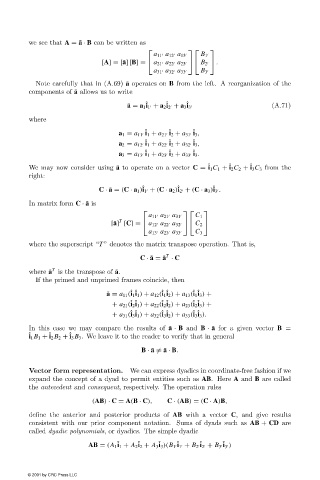
we see that A = ¯ a · B can be written as
a 11 a 12 a 13 B 1
[A] = [¯ a][B] = a 21 a 22 a 23 B 2 .
a 31 a 32 a 33 B 3
Note carefully that in (A.69) ¯ a operates on B from the left. A reorganization of the
components of ¯ a allows us to write
¯ a = a 1 i 1 + a 2 i 2 + a 3 i 3 (A.71)
ˆ
ˆ
ˆ
where
ˆ
ˆ
ˆ
a 1 = a 11 i 1 + a 21 i 2 + a 31 i 3 ,
ˆ
ˆ
ˆ
a 2 = a 12 i 1 + a 22 i 2 + a 32 i 3 ,
ˆ
ˆ
ˆ
a 3 = a 13 i 1 + a 23 i 2 + a 33 i 3 .
ˆ
ˆ
ˆ
We may now consider using ¯ a to operate on a vector C = i 1 C 1 + i 2 C 2 + i 3 C 3 from the
right:
C · ¯ a = (C · a 1 )i 1 + (C · a 2 )i 2 + (C · a 3 )i 3 .
ˆ
ˆ
ˆ
In matrix form C · ¯ a is
a 11 a 21 a 31 C 1
T
[¯ a] [C] = a 12 a 22 a 32 C 2
a 13 a 23 a 33 C 3
where the superscript “T ” denotes the matrix transpose operation. That is,
T
C · ¯ a = ¯ a · C
T
where ¯ a is the transpose of ¯ a.
If the primed and unprimed frames coincide, then
ˆ ˆ ˆ ˆ ˆ ˆ
¯ a = a 11 (i 1 i 1 ) + a 12 (i 1 i 2 ) + a 13 (i 1 i 3 ) +
ˆ ˆ ˆ ˆ ˆ ˆ
+ a 21 (i 2 i 1 ) + a 22 (i 2 i 2 ) + a 23 (i 2 i 3 ) +
ˆ ˆ
ˆ ˆ
ˆ ˆ
+ a 31 (i 3 i 1 ) + a 32 (i 3 i 2 ) + a 33 (i 3 i 3 ).
In this case we may compare the results of ¯ a · B and B · ¯ a for a given vector B =
ˆ i 1 B 1 + i 2 B 2 + i 3 B 3 . We leave it to the reader to verify that in general
ˆ
ˆ
B · ¯ a = ¯ a · B.
Vector form representation. We can express dyadics in coordinate-free fashion if we
expand the concept of a dyad to permit entities such as AB. Here A and B are called
the antecedent and consequent, respectively. The operation rules
(AB) · C = A(B · C), C · (AB) = (C · A)B,
define the anterior and posterior products of AB with a vector C, and give results
consistent with our prior component notation. Sums of dyads such as AB + CD are
called dyadic polynomials, or dyadics. The simple dyadic
ˆ
ˆ
ˆ
AB = (A 1 i 1 + A 2 i 2 + A 3 i 3 )(B 1 i 1 + B 2 i 2 + B 3 i 3 )
ˆ
ˆ
ˆ
© 2001 by CRC Press LLC

