


Page 277 - Electromechanical Devices and Components Illustrated Sourcebook
P. 277
Chapter 13  Meters 239

                                Voltmeter                        Normally a decade resistance box, as discussed in Chapter 4,
                                                              is set up as one of the known resistors. In this manner, the
                                                  Battery
                                                              range of the bridge can easily be adjusted. The variable resis-
                             V
                                                              tor is generally a calibrated test unit. Using a digital multime-
                                                              ter and progressively selecting lower voltage ranges can make
                                                              an extremely accurate measurement.
          Resistor to be
           Measured
                                   A
                                                              The SlideWire Bridge

                                        Ampmeter
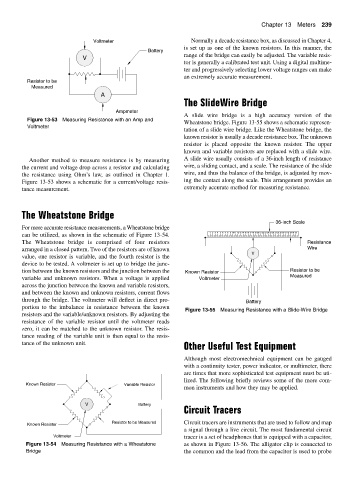
                                                              A slide wire bridge is a high accuracy version of the
          Figure 13-53 Measuring Resistance with an Amp and
                                                              Wheatstone bridge. Figure 13-55 shows a schematic represen-
          Voltmeter
                                                              tation of a slide wire bridge. Like the Wheatstone bridge, the
                                                              known resistor is usually a decade resistance box. The unknown
                                                              resistor is placed opposite the known resistor.  The upper
                                                              known and variable resistors are replaced with a slide wire.
           Another method to measure resistance is by measuring  A slide wire usually consists of a 36-inch length of resistance
        the current and voltage drop across a resistor and calculating  wire, a sliding contact, and a scale. The resistance of the slide
        the resistance using Ohm’s law, as outlined in Chapter 1.  wire, and thus the balance of the bridge, is adjusted by mov-
        Figure 13-53 shows a schematic for a current/voltage resis-  ing the contact along the scale. This arrangement provides an
        tance measurement.                                    extremely accurate method for measuring resistance.


        The Wheatstone Bridge
                                                                                             36-inch Scale
        For more accurate resistance measurements, a Wheatstone bridge
        can be utilized, as shown in the schematic of Figure 13-54.    123456789 10 11 12 13 14 15 16 17 18 19 20 21 22 23 24 25 26 27 28 29 30 31 32 33 34 35
        The  Wheatstone bridge is comprised of four resistors                                          Resistance
        arranged in a closed pattern. Two of the resistors are of known                                Wire
                                                                                     V
        value, one resistor is variable, and the fourth resistor is the
        device to be tested. A voltmeter is set up to bridge the junc-
        tion between the known resistors and the junction between the  Known Resistor             Resistor to be
        variable and unknown resistors. When a voltage is applied  Voltmeter                      Measured
        across the junction between the known and variable resistors,
        and between the known and unknown resistors, current flows
        through the bridge. The voltmeter will deflect in direct pro-               Battery
        portion to the imbalance in resistance between the known
                                                               Figure 13-55 Measuring Resistance with a Slide-Wire Bridge
        resistors and the variable/unknown resistors. By adjusting the
        resistance of the variable resistor until the voltmeter reads
        zero, it can be matched to the unknown resistor. The resis-
        tance reading of the variable unit is then equal to the resis-
        tance of the unknown unit.
                                                              Other Useful Test Equipment
                                                              Although most electromechnical equipment can be gauged
                                                              with a continuity tester, power indicator, or multimeter, there
                                                              are times that more sophisticated test equipment must be uti-
                                                              lized. The following briefly reviews some of the more com-
          Known Resistor                  Variable Resistor
                                                              mon instruments and how they may be applied.

                             V                 Battery
                                                              Circuit Tracers

                                      Resistor to be Measured  Circuit tracers are instruments that are used to follow and map
          Known Resistor
                                                              a signal through a live circuit. The most fundamental circuit
                   Voltmeter                                  tracer is a set of headphones that is equipped with a capacitor,
          Figure 13-54 Measuring Resistance with a Wheatstone  as shown in Figure 13-56. The alligator clip is connected to
          Bridge                                              the common and the lead from the capacitor is used to probe

