


Page 108 - Encyclopedia of Chemical Compounds 3 Vols
P. 108
H

                                                                    N
                                                               H         H


                    OTHER NAMES:
                           None
                                         Ammonia
                        FORMULA:
                            NH 3
                       ELEMENTS:
               Nitrogen, hydrogen
                                         OVERVIEW
                  COMPOUND TYPE:  KE
                   Inorganic base            Ammonia (uh-MOH-nyah) is a colorless gas with a strong,
                                         suffocating odor. It was present in the primordial (original)
                          STATE:
                                 Y
                                         atmosphere of the Earth. Scientists believe that it may have
                            Gas  F
                                         been the source of nitrogen for the earliest forms of life.
                MOLECULAR WEIGHT:  A     Ammonia was the first chemical compound to be found
                      17.03 g/mol  C     in interstellar space, the space between stars. It is a major
                                         component of the atmosphere of many planets in our solar
                   MELTING POINT:  T
                                         system.
                  77.7 C( 108 F)  S
                                             Early chemists learned to produce ammonia from animal
                    BOILING POINT:
                                         parts, such as the horns of deer. But it was the English
               33.35 C( 28.03 F)
                                         chemist and physicist Joseph Priestley (1733–1804) who first
                      SOLUBILITY:
                                         collected and studied the pure gas. In 1785, the French che-
               Very soluble in cold
                                         mist Claude-Louis Berthollet (1748–1822) determined the cor-
                  water; soluble in
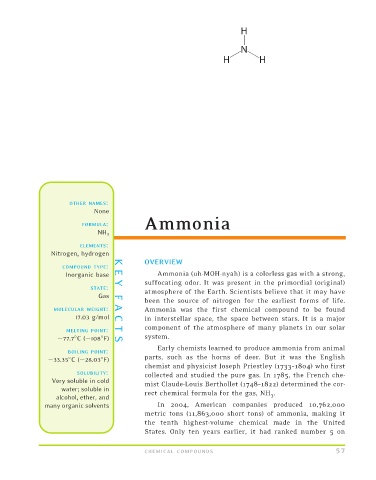
                                         rect chemical formula for the gas, NH 3 .
                 alcohol, ether, and
             many organic solvents           In 2004, American companies produced 10,762,000
                                         metric tons (11,863,000 short tons) of ammonia, making it
                                         the tenth highest-volume chemical made in the United
                                         States. Only ten years earlier, it had ranked number 5 on

                                         CHEMICAL COMPOUNDS                                   57

