


Page 109 - Encyclopedia of Chemical Compounds 3 Vols
P. 109
AMMONIA


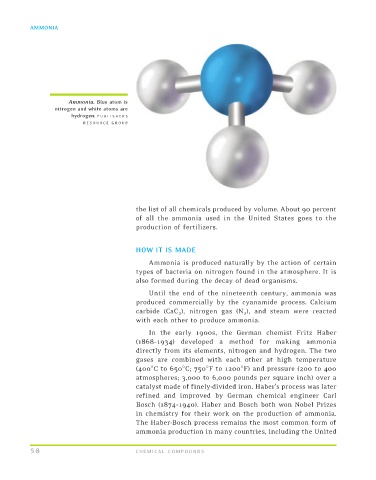
                    Ammonia. Blue atom is
                nitrogen and white atoms are
                     hydrogen. PU BL I S HERS
                        RESOURCE GRO U P


                                       the list of all chemicals produced by volume. About 90 percent
                                       of all the ammonia used in the United States goes to the
                                       production of fertilizers.


                                       HOW IT IS MADE
                                          Ammonia is produced naturally by the action of certain
                                       types of bacteria on nitrogen found in the atmosphere. It is
                                       also formed during the decay of dead organisms.
                                          Until the end of the nineteenth century, ammonia was
                                       produced commercially by the cyanamide process. Calcium
                                       carbide (CaC 2 ), nitrogen gas (N 2 ), and steam were reacted
                                       with each other to produce ammonia.
                                          In the early 1900s, the German chemist Fritz Haber
                                       (1868–1934) developed a method for making ammonia
                                       directly from its elements, nitrogen and hydrogen. The two
                                       gases are combined with each other at high temperature


                                       (400 C to 650 C; 750 F to 1200 F) and pressure (200 to 400
                                       atmospheres; 3,000 to 6,000 pounds per square inch) over a
                                       catalyst made of finely-divided iron. Haber’s process was later
                                       refined and improved by German chemical engineer Carl
                                       Bosch (1874–1940). Haber and Bosch both won Nobel Prizes
                                       in chemistry for their work on the production of ammonia.
                                       The Haber-Bosch process remains the most common form of
                                       ammonia production in many countries, including the United


         58                            CHEMICAL COMPOUNDS

