


Page 115 - Encyclopedia of Chemical Compounds 3 Vols
P. 115
AMMONIUM CHLORIDE


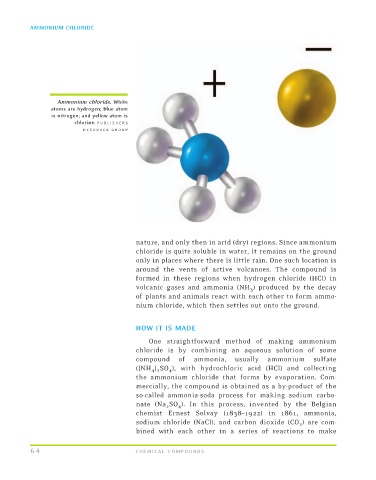
                 Ammonium chloride. White
               atoms are hydrogen; blue atom
               is nitrogen; and yellow atom is
                      chlorine. PU BL I S HERS
                        RESOURCE GRO U P


                                       nature, and only then in arid (dry) regions. Since ammonium
                                       chloride is quite soluble in water, it remains on the ground
                                       only in places where there is little rain. One such location is
                                       around the vents of active volcanoes. The compound is
                                       formed in these regions when hydrogen chloride (HCl) in
                                       volcanic gases and ammonia (NH 3 ) produced by the decay
                                       of plants and animals react with each other to form ammo-
                                       nium chloride, which then settles out onto the ground.


                                       HOW IT IS MADE

                                          One straightforward method of making ammonium
                                       chloride is by combining an aqueous solution of some
                                       compound   of   ammonia,   usually  ammonium     sulfate
                                       ([NH 4 ] 2 SO 4 ), with hydrochloric acid (HCl) and collecting
                                       the ammonium chloride that forms by evaporation. Com-
                                       mercially, the compound is obtained as a by-product of the
                                       so-called ammonia-soda process for making sodium carbo-
                                       nate (Na 2 SO 4 ). In this process, invented by the Belgian
                                       chemist Ernest Solvay (1838–1922) in 1861, ammonia,
                                       sodium chloride (NaCl), and carbon dioxide (CO 2 )are com-
                                       bined with each other in a series of reactions to make


         64                            CHEMICAL COMPOUNDS

