


Page 142 - Engineered Interfaces in Fiber Reinforced Composites
P. 142
Chapter 4. Micromechunics of  stress  transfer   125

               (stress) is increased, there is a competition between interface debonding and matrix
               crack  propagation.  This  phenomenon  of  fiber  fragmentation  has  been  recently
               analyzed by Liu et al.( 1997) using fracture mechanics and a constant average fiber
               strength model.


               4.3.  Fiber pull-out test
               4.3.1. Introduction


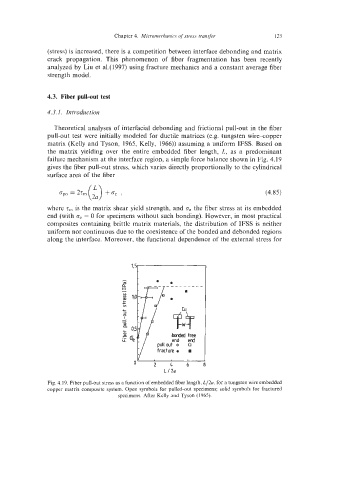
                 Theoretical  analyses of interfacial  debonding and frictional pull-out in the fiber
               pull-out test were initially modeled for ductile matrices (e.g. tungsten wiresopper
               matrix (Kelly and Tyson,  1965, Kelly,  1966)) assuming a uniform  IFSS. Based on
                the  matrix  yielding  over  the  entire  embedded  fiber  length,  L, as  a  predominant
                failure mechanism at the interface region, a simple force balance shown in Fig. 4.19
               gives the fiber pull-out stress, which varies directly proportionally to the cylindrical
               surface area of the fiber


                                                                                 (4.85)
               where r,  is the matrix shear yield strength, and oe the fiber stress at its embedded
               end (with ge = 0 for specimens without such bonding). However, in most practical
               composites containing brittle matrix materials,  the distribution  of  IFSS is neither
               uniform nor continuous due to the coexistence of the bonded and debonded regions
               along the interface. Moreover, the functional dependence of the external stress for


                                       %,I P         bonded  free
                                                     end   end
                                                 pull out  0   0

                                          0     2   4    6
                                                   LI2a

                Fig. 4.19. Fiber pull-out stress as a function of embedded fiber length, L/2a, for a tungsten wire embedded
               copper  matrix composite system. Open  symbols for pulled-out  specimens; solid  symbols for  fractured
                                     specimens. After Kelly and Tyson (1965).

