


Page 141 - Engineering Digital Design
P. 141
112                           CHAPTER 3 / BACKGROUND FOR DIGITAL DESIGN


                                          (X-F)0(X-Z)=X.(r0Z )         Factoring Law
                     Distributive Laws  {                                            } (3.19)
                                        (X + Y)Q(X + Z) = X + (YQZ) Distributive Law

                      Absorptive Laws  {      _             [                           (3.20)


                       Consensus Laws  {                                           }    (3.21)
                                        \(X + Y) 0 (X + Z) • (7 + Z) = (X + F) O (X + Z)f


                     DeMorgan's Laws   {         _            \.                        (3.22)
                                        \x e y = x o F = x o n

                    Notice that each of the six sets of equations are presented in dual form. Thus, by interchang-
                    ing AND and OR operators while simultaneously interchanging EQV and XOR operators,
                    duality of the set is established. The first of the distributive laws given in Eqs. (3.19) can be
                    termed the factoring law of XOR algebra owing to its similarity with the factoring law of
                    Cartesian algebra and that of Eqs. (3.12).
                      Generalizations of DeMorgan's XOR laws follow from Eqs. (3.15a) and (3.22) and are
                    given by


                    and                                                               (3.22a)


                      Verification of the associative, commutative, and distributive laws is easily accomplished
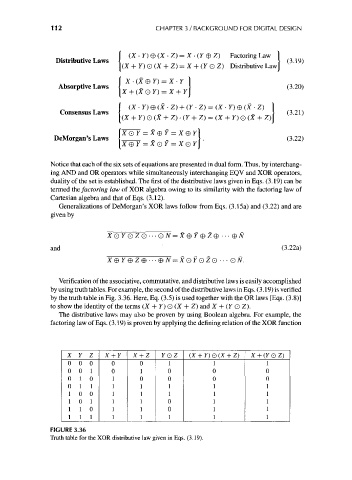
                    by using truth tables. For example, the second of the distributive laws in Eqs. (3.19) is verified
                    by the truth table in Fig. 3.36. Here, Eq. (3.5) is used together with the OR laws [Eqs. (3.8)]
                    to show the identity of the terms (X + Y) O (X + Z) and X + (Y Q Z).
                      The distributive laws may also be proven by using Boolean algebra. For example, the
                    factoring law of Eqs. (3.19) is proven by applying the defining relation of the XOR function


                         X  Y  Z    X + Y   x + z   YQZ     (X + F) 0 (X + Z)  X + (Y 0 Z)
                         00 0        0        0       1            1              1
                         0 0 1       0        1       0           0               0
                         0 1 0        1       0       0           0               0
                         0  1 1       1       1       1            1              1
                         1 0 0        1       1       1            1              1
                         1 0 1        1       1       0            1              1
                         1  1 0       1       1       0            1              1
                         1  1 1       1       1       1            1              1

                    FIGURE 3.36
                    Truth table for the XOR distributive law given in Eqs. (3.19).

