


Page 289 - Essentials of physical chemistry
P. 289
The Schrödinger Wave Equation                                               251

            STUDY, TEST, AND LEARN?

            Realistically, Chapters 10 and 11 contain some important material that is perhaps the last really
            ‘‘must learn’’ material in the second semester. There is a considerable amount of basic physics in
            Chapter 10, and Chapter 11 has the basic concepts of quantum chemistry. From now on, the material
            will emphasize learning the main conclusions but only using the mathematics as a reference.
            However, this is a good point to have a quiz over Chapters 10 and 11. On another page we will
            show some tests from a nearby four year Liberal Arts College, Randolph Macon College where the
            physical chemistry courses are CHEM 311 and 312 with 312 as an elective.
              Once again, the students were encouraged to memorize derivations and to try to answer every
            question with the additional knowledge that their grade would be based on the grade they
            achieve on the final examination or their average including the final examination grade, whichever
            is higher.


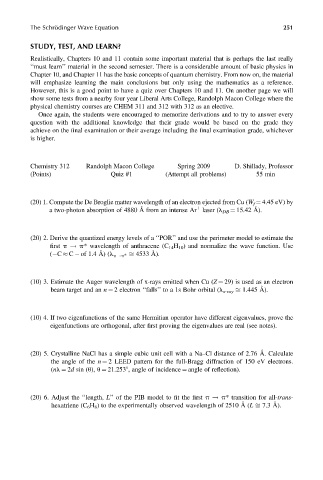
            Chemistry 312    Randolph Macon College     Spring 2009      D. Shillady, Professor
            (Points)                Quiz #1         (Attempt all problems)      55 min


            (20) 1. Compute the De Broglie matter wavelength of an electron ejected from Cu (W f ¼ 4.45 eV) by
                 a two-photon absorption of 4880 Å from an intense Ar laser (l DB ¼ 15.42 Å).
                                                              þ


            (20) 2. Derive the quantized energy levels of a ‘‘POR’’ and use the perimeter model to estimate the
                  first p ! p* wavelength of anthracene (C 14 H 10 ) and normalize the wave function. Use
                  ( C   C   of 1.4 Å) (l p!p* ffi 4533 A ˚ ).


            (10) 3. Estimate the Auger wavelength of x-rays emitted when Cu (Z ¼ 29) is used as an electron
                  beam target and an n ¼ 2 electron ‘‘falls’’ to a 1s Bohr orbital (l x-ray ffi 1.445 Å).


            (10) 4. If two eigenfunctions of the same Hermitian operator have different eigenvalues, prove the
                  eigenfunctions are orthogonal, after first proving the eigenvalues are real (see notes).


            (20) 5. Crystalline NaCl has a simple cubic unit cell with a Na–Cl distance of 2.76 Å. Calculate
                  the angle of the n ¼ 2 LEED pattern for the full-Bragg diffraction of 150 eV electrons.
                  (nl ¼ 2d sin (u), u ¼ 21.2538, angle of incidence ¼ angle of reflection).


            (20) 6. Adjust the ‘‘length, L’’ of the PIB model to fit the first p ! p* transition for all-trans-
                  hexatriene (C 6 H 8 ) to the experimentally observed wavelength of 2510 Å (L ffi 7.3 Å).

