


Page 286 - Essentials of physical chemistry
P. 286
248                                                  Essentials of Physical Chemistry

            which may help with approximate solutions to unsolved problems. The first useful concept is really
            a self-fulfilling definition that helps enforce quantum mechanics agree with laboratory measure-
            ments in spite of the complications due to complex arithmetic.


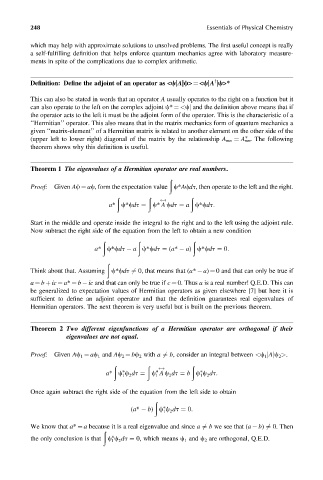
            Definition: Define the adjoint of an operator as <c|A|c> ¼ <c|A |c>*
                                                                   y
            This can also be stated in words that an operator A usually operates to the right on a function but it
            can also operate to the left on the complex adjoint c* ¼ <cj and the definition above means that if
            the operator acts to the left it must be the adjoint form of the operator. This is the characteristic of a
            ‘‘Hermitian’’ operator. This also means that in the matrix mechanics form of quantum mechanics a
            given ‘‘matrix-element’’ of a Hermitian matrix is related to another element on the other side of the
                                                                            *
            (upper left to lower right) diagonal of the matrix by the relationship A mn ¼ A nm . The following
            theorem shows why this definition is useful.

            Theorem 1 The eigenvalues of a Hermitian operator are real numbers.

                                                     ð
            Proof:  Given Ac ¼ ac, form the expectation value c*Acdt, then operate to the left and the right.
                                      ð        ð            ð
                                   a* c*cdt ¼ c* A cdt ¼ a c*cdt:
                                                   $

            Start in the middle and operate inside the integral to the right and to the left using the adjoint rule.
            Now subtract the right side of the equation from the left to obtain a new condition
                                 ð          ð               ð
                               a* c*cdt   a c*cdt ¼ (a*   a) c*cdt ¼ 0:


                                   ð
            Think about that. Assuming c*cdt 6¼ 0, that means that (a*   a) ¼ 0 and that can only be true if
            a ¼ b þ ic ¼ a* ¼ b   ic and that can only be true if c ¼ 0. Thus a is a real number! Q.E.D. This can
            be generalized to expectation values of Hermitian operators as given elsewhere [7] but here it is
            sufficient to define an adjoint operator and that the definition guarantees real eigenvalues of
            Hermitian operators. The next theorem is very useful but is built on the previous theorem.


            Theorem 2 Two different eigenfunctions of a Hermitian operator are orthogonal if their
                       eigenvalues are not equal.

            Proof:  Given Ac 1 ¼ ac 1 and Ac 2 ¼ bc 2 with a 6¼ b, consider an integral between <c 1 jAjc 2 >.

                                     ð         ð            ð
                                                  $
                                  a* c * c dt ¼ c * A c dt ¼ b c * c dt:
                                       1 2       1   2         1 2
            Once again subtract the right side of the equation from the left side to obtain

                                                 ð
                                          (a*   b) c * c dt ¼ 0:
                                                    1 2
            We know that a* ¼ a because it is a real eigenvalue and since a 6¼ b we see that (a   b) 6¼ 0. Then
                                  ð
            the only conclusion is that  c * c dt ¼ 0, which means c 1 and c 2 are orthogonal, Q.E.D.
                                    1 2

