


Page 283 - Essentials of physical chemistry
P. 283
The Schrödinger Wave Equation                                               245

            r ffiffiffiffiffiffiffiffiffiffiffiffiffiffi      2 2
                 2
              2ma E              n   h                                         inu
                                    , n ¼ 0,  1,  2, . . .. Then we also find that c n ¼ Ce  , n ¼ 0,  1,
                 2
                  h             2ma 2
                    ¼ n ) E n ¼
             2, . . .. Note there is a solution for n ¼ 0 in this case! Also we have what are called degenerate
            solutions for n ¼ 1,  2, . . ., that is for a given n-level there are two states with the same energy.
            States with the same energy but different wave functions are said to be degenerate.
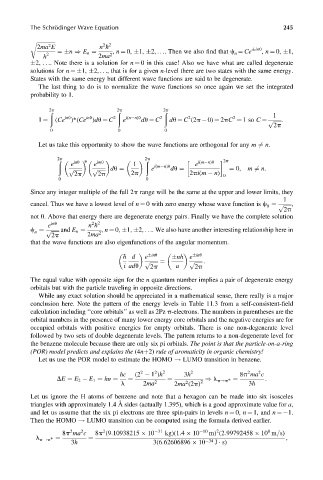
              The last thing to do is to normalize the wave functions so once again we set the integrated
            probability to 1.
                 2p                   2p            2p
                  ð                   ð             ð                                1
                            inu
                                                           2
                                                                         2
                      inu
                   (Ce )*(Ce )du ¼ C 2  e i(n n)u du ¼ C 2  du ¼ C (2p 0) ¼ 2pC ¼ 1so C ¼ ffiffiffiffiffiffi.
              1 ¼                                                                  p
                                                                                     2p
                  0                   0             0
              Let us take this opportunity to show the wave functions are orthogonal for any m 6¼ n.
                                              ð 2p
                    ð 2p    inu *  imu                        i(m n)u    2p

                        e      e           1     i(m n)u     e
                                                e                      ¼ 0,  m 6¼ n:
                         ffiffiffiffiffiffi
                       p      p ffiffiffiffiffiffi du ¼           du ¼
                         2p     2p        2p                2pi(m   n)  0
                    0                         0
            Since any integer multiple of the full 2p range will be the same at the upper and lower limits, they
                                                                                        1
                                                                                   0
            cancel. Thus we have a lowest level of n ¼ 0 with zero energy whose wave function is c ¼ p ffiffiffiffiffiffi,
                                                                                        2p
            not 0. Above that energy there are degenerate energy pairs. Finally we have the complete solution
                              2 2
                               h
                 e inu       n
                                 , n ¼ 0,  1,  2, . . .. We also have another interesting relationship here in
             n
            c ¼ p ffiffiffiffiffiffi and E n ¼  2
                  2p         2ma
            that the wave functions are also eigenfunctions of the angular momentum.
                                                inu           inu
                                          h d  e       n  e
                                                         h
                                                             ffiffiffiffiffiffi :
                                                ffiffiffiffiffiffi ¼
                                              p
                                                           p
                                        i adu   2p     a     2p
            The equal value with opposite sign for the n quantum number implies a pair of degenerate energy
            orbitals but with the particle traveling in opposite directions.
              While any exact solution should be appreciated in a mathematical sense, there really is a major
            conclusion here. Note the pattern of the energy levels in Table 11.3 from a self-consistent-field
            calculation including ‘‘core orbitals’’ as well as 2Pz p-electrons. The numbers in parentheses are the
            orbital numbers in the presence of many lower energy core orbitals and the negative energies are for
            occupied orbitals with positive energies for empty orbitals. There is one non-degenerate level
            followed by two sets of double degenerate levels. The pattern returns to a non-degenerate level for
            the benzene molecule because there are only six pi orbitals. The point is that the particle-on-a-ring
            (POR) model predicts and explains the (4nþ2) rule of aromaticity in organic chemistry!
              Let us use the POR model to estimate the HOMO ! LUMO transition in benzene.
                                                 2
                                             2
                                                                                2
                                                                             2
                                       hc  (2   1 )  2    3h 2             8p ma c
                                                   h
                                       l      2ma      2ma (2p)              3h
                    DE ¼ E 2   E 1 ¼ hn ¼  ¼     2   ¼    2    2  ) l p!p* ¼      :
            Let us ignore the H atoms of benzene and note that a hexagon can be made into six isosceles
            triangles with approximately 1.4 Å sides (actually 1.395), which is a good approximate value for a,
            and let us assume that the six pi electrons are three spin-pairs in levels n ¼ 0, n ¼ 1, and n ¼ 1.
            Then the HOMO ! LUMO transition can be computed using the formula derived earlier.
                                                                    2
                                                                                   8
                        2
                           2
                                  2
                     8p ma c   8p (9:10938215   10  31  kg)(1:4   10  10  m) (2:99792458   10 m=s)
                                                                                        ,
             l p!p* ¼        ¼                                   34
                        3h                       3(6:62606896   10  J   s)

