


Page 280 - Essentials of physical chemistry
P. 280
242                                                  Essentials of Physical Chemistry

              Heisenberg [3] is widely credited with pointing out this problem from a statistical point of view
                                                           2
                                                   2
                                           2
                                                                               2
                                                                     2
                                                                                         2
            and we can define the ‘‘variance’’ as s (x) ¼ <x >   <x> and also s (P x ) ¼ <P >   <P x > .
                                                                               x
            Then we can consider the fact that x is the corresponding coordinate to P x and wonder about their
                                                               . Here we come to some intricate
            mutual effect on each other. Thus consider the product s x s P x
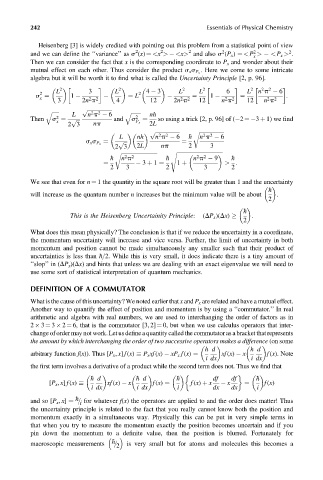
            algebra but it will be worth it to find what is called the Uncertainty Principle [2, p. 96].
                     2
                                                         2      2             2     2  2
                                      2
                   L         3       L         4   3    L     L        6     L  n p   6
               2                            2
               x
                    3      2n p       4         12     2n p   12     n p     12   n p
             s ¼        1    2  2        ¼ L             2  2  ¼  1    2  2  ¼     2  2  :
                             ffiffiffiffiffiffiffiffiffiffiffiffiffiffiffiffiffiffi
                           p
                        L    n p   6            nh
                q ffiffiffiffiffi       2  2      q ffiffiffiffiffiffiffi
            Then    2                and  s 2     so using a trick [2, p. 96] of ( 2 ¼ 3 þ 1) we find
                    x     ffiffiffi              P x  ¼
                  s ¼ p
                       2 3     np              2L
                                                             r ffiffiffiffiffiffiffiffiffiffiffiffiffiffiffiffiffiffi
                                                 ffiffiffiffiffiffiffiffiffiffiffiffiffiffiffiffiffiffi
                                                p
                                                  2
                                                                  2
                                                                2
                                                    2
                                      L     nh   n p   6    h  n p   6
                            s x s P x  ¼  p ffiffiffi          ¼
                                     2 3    2L     np      2      3
                                                      s ffiffiffiffiffiffiffiffiffiffiffiffiffiffiffiffiffiffiffiffiffiffiffiffiffiffiffiffiffiffiffiffiffi
                                     r ffiffiffiffiffiffiffiffiffiffiffiffiffiffiffiffiffiffiffiffiffiffiffiffiffiffi

                                                                2
                                        2
                                                              2
                                      h  n p 2        h      n p   9      h
                                                                      > :
                                  ¼          3 þ 1 ¼    1 þ
                                    2    3          2           3       2
            We see that even for n ¼ 1 the quantity in the square root will be greater than 1 and the uncertainty

                                                                                     h
            will increase as the quantum number n increases but the minimum value will be about  .
                                                                                   2

                                                                              h
                        This is the Heisenberg Uncertainity Principle:  (DP x )(Dx)    :
                                                                            2
            What does this mean physically? The conclusion is that if we reduce the uncertainty in a coordinate,
            the momentum uncertainty will increase and vice versa. Further, the limit of uncertainty in both
            momentum and position cannot be made simultaneously any smaller such that their product of
            uncertainties is less than  =2. While this is very small, it does indicate there is a tiny amount of
                                h
            ‘‘slop’’ in (DP x )(Dx) and hints that unless we are dealing with an exact eigenvalue we will need to
            use some sort of statistical interpretation of quantum mechanics.
            DEFINITION OF A COMMUTATOR
            What is the cause of this uncertainty? We noted earlier that x and P x are related and have a mutual effect.
            Another way to quantify the effect of position and momentum is by using a ‘‘commutator.’’ In real
            arithmetic and algebra with real numbers, we are used to interchanging the order of factors as in
            2   3 ¼ 3   2 ¼ 6, that is the commutator [3, 2] ¼ 0, but when we use calculus operators that inter-
            change of order may not work. Let us define a quantity called the commutator as a bracket that represents
            the amount by which interchanging the order of two successive operators makes a difference (on some

                                                                  h d           h d
                                                                     xf(x)   x     f (x).Note
                                                                i dx          i dx
            arbitrary function f(x)). Thus [P x , x] f (x)   P x xf(x)   xP x f (x) ¼
            the first term involves a derivative of a product while the second term does not. Thus we find that

                               h d          h d           h        df   df        h
                                   xf (x)   x               f (x) þ x    x        f (x)
                 [P x , x] f (x)                f (x) ¼                     ¼
                              i dx          i dx        i          dx   dx      i
                           h
            and so [P x , x] ¼ = for whatever f(x) the operators are applied to and the order does matter! Thus
                           i
            the uncertainty principle is related to the fact that you really cannot know both the position and
            momentum exactly in a simultaneous way. Physically this can be put in very simple terms in
            that when you try to measure the momentum exactly the position becomes uncertain and if you
            pin down the momentum to a definite value, then the position is blurred. Fortunately for

            macroscopic measurements    h = 2  is very small but for atoms and molecules this becomes a

