


Page 284 - Essentials of physical chemistry
P. 284
246                                                  Essentials of Physical Chemistry


                              TABLE 11.3
                              STO-3G One-Electron Energies for Pi-Molecular
                              Orbitals of Benzene (Hartrees)

                              E(24) ¼ 0.4940
                              E(23) ¼ 0.2664
                              E(22) ¼ 0.2664
                              E(21) ¼ 0.2699
                              E(20) ¼ 0.2699
                              E(17) ¼ 0.4354

                              Note: STO-3G ) Slater-type-orbitals  fitted  with  a  linear
                                   combination of three Gaussian orbitals. See Chapter 17.


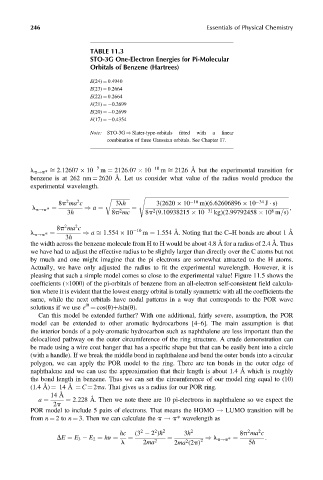
            l p!p* ffi 2:12607   10  7  m ¼ 2126:07   10  10  m ffi 2126 Å but the experimental transition for
            benzene is at 262 nm ¼ 2620 Å. Let us consider what value of the radius would produce the
            experimental wavelength.
                                            s ffiffiffiffiffiffiffiffiffiffiffiffiffiffiffiffiffiffiffiffiffiffiffiffiffiffiffiffiffiffiffiffiffiffiffiffiffiffiffiffiffiffiffiffiffiffiffiffiffiffiffiffiffiffiffiffiffiffiffiffiffiffiffiffiffiffiffiffiffiffiffiffiffiffiffiffiffiffiffiffiffiffiffiffiffiffiffiffiffiffiffiffiffiffiffiffiffiffiffiffiffiffiffiffi
                                  r ffiffiffiffiffiffiffiffiffiffiffiffiffiffi
                       2
                          2
                    8p ma c          3lh          3(2620   10  10  m)(6:62606896   10  34  J   s)
                                                                                          ,
            l p!p* ¼        ) a ¼      2  ¼      2               31                 8
                       3h           8p mc     8p (9:10938215   10  kg)(2:99792458   10 m=s)
                         2
                      2
                    8p ma c                 10
                           ) a ffi 1:554   10   m ¼ 1:554 Å. Noting that the C–H bonds are about 1 Å
                      3h
            l p!p* ¼
            the width across the benzene molecule from H to H would be about 4.8 Å for a radius of 2.4 Å. Thus
            we have had to adjust the effective radius to be slightly larger than directly over the C atoms but not
            by much and one might imagine that the pi electrons are somewhat attracted to the H atoms.
            Actually, we have only adjusted the radius to fit the experimental wavelength. However, it is
            pleasing that such a simple model comes so close to the experimental value! Figure 11.5 shows the
            coefficients ( 1000) of the pi-orbitals of benzene from an all-electron self-consistent field calcula-
            tion where it is evident that the lowest energy orbital is totally symmetric with all the coefficients the
            same, while the next orbitals have nodal patterns in a way that corresponds to the POR wave
                            iu
            solutions if we use e ¼ cos(u)þisin(u).
              Can this model be extended further? With one additional, fairly severe, assumption, the POR
            model can be extended to other aromatic hydrocarbons [4–6]. The main assumption is that
            the interior bonds of a poly-aromatic hydrocarbon such as naphthalene are less important than the
            delocalized pathway on the outer circumference of the ring structure. A crude demonstration can
            be made using a wire coat hanger that has a specific shape but that can be easily bent into a circle
            (with a handle). If we break the middle bond in naphthalene and bend the outer bonds into a circular
            polygon, we can apply the POR model to the ring. There are ten bonds in the outer edge of
            naphthalene and we can use the approximation that their length is about 1.4 Å which is roughly
            the bond length in benzene. Thus we can set the circumference of our model ring equal to (10)
            (1.4 Å) ¼ 14 Å ¼ C ¼ 2pa. That gives us a radius for our POR ring.
                  14 A ˚
                      ¼ 2:228 Å. Then we note there are 10 pi-electrons in naphthalene so we expect the
                   2p
              a ¼
            POR model to include 5 pairs of electrons. That means the HOMO ! LUMO transition will be
            from n ¼ 2to n ¼ 3. Then we can calculate the p ! p* wavelength as
                                                 2
                                                                                2
                                                                             2
                                             2
                                       hc  (3   2 )  2    3h 2             8p ma c
                                                   h
                                                                                  :
                    DE ¼ E 3   E 2 ¼ hn ¼  ¼     2   ¼    2    2  ) l p!p* ¼
                                       l      2ma      2ma (2p)              5h

