


Page 279 - Essentials of physical chemistry
P. 279
The Schrödinger Wave Equation                                               241

            probable position ‘‘x’’ the particle will have in the lowest energy state. Although we can treat the
            coordinate as an operator, x ! x op , the function is not an eigenfunction of this operator! We can see
                     r ffiffiffi

                       2     1px
                  1
            that xc ¼   x sin     is just another function of x, not an eigenfunction. However, there is
                       L      L
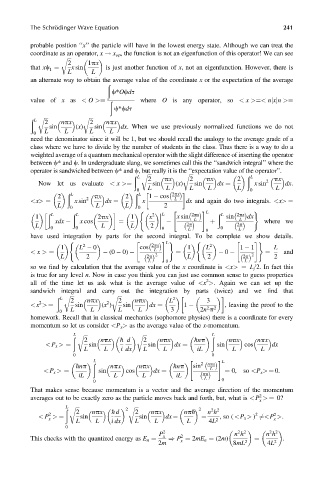
            an alternate way to obtain the average value of the coordinate x or the expectation of the average
                                   ð
                                    c*Ocdt
            value of x as < O >  ð           where O is any operator, so < x >¼< njxjn >
                                     c*cdt
              r ffiffiffi         r ffiffiffi
             L
            ð
                2    npx      2    npx
                 sin     (x)   sin     dx. When we use previously normalized functions we do not
                L     L       L     L
             0
            need the denominator since it will be 1, but we should recall the analogy to the average grade of a
            class where we have to divide by the number of students in the class. Thus there is a way to do a
            weighted average of a quantum mechanical operator with the slight difference of inserting the operator
            between c*and c. In undergraduate slang, we sometimes call this the ‘‘sandwich integral’’ where the
            operator is sandwiched between c*and c, but really it is the ‘‘expectation value of the operator’’.
                                             r ffiffiffi        r ffiffiffi
                                            L                                 L
                                           ð                               ð
                                               2    px      2   px        2        2  px
                                                sin    (x)   sin               x sin    dx:
              Now let us evaluate < x >¼       L     L      L    L  dx ¼  L          L
                                            0                                 0

                     ð  L                 ð L         2px
                    2        2    px    2      1   cos  L
                         x sin               x
            <x> ¼                 dx ¼                    dx and again do two integrals. <x> ¼
                    L   0      L        L   0       2
                                            (          "        L
                                                           	    #        	    )
               ð  L     ð L                        L        2px     ð  L  2px
             1                  2px       1    x  2     x sin  L       sin  L  dx
                           x cos      ¼                   	       þ      	        where we
                   xdx
             L    0      0       L        L     2    0     2p   0    0    2p
                                                                          L
                                                           L
            have used integration by parts for the second integral. To be complete we show details.
                       (                   "        L        (            "    #)
                                               	    # )
                            2                   2px
                                                                  2
                     1    L   0              cos           1    L          1   1     L
                                                 L
                     L       2                 2p          L     2          2p       2
            < x > ¼                (0   0)    	  2     ¼              0   	   2   ¼     and
                                               L    0                       L
            so we find by calculation that the average value of the x coordinate is <x> ¼ L=2. In fact this
            is true for any level n. Now in case you think you can just use common sense to guess properties
                                                                 2
            all of the time let us ask what is the average value of <x >. Again we can set up the
            sandwich integral and carry out the integration by parts (twice) and we find that
                      r ffiffiffi         r ffiffiffi
                     L                                 2
                    ð
              2         2    npx   2  2    npx       L           3
            <x > ¼       sin     (x )   sin    dx ¼       1      2  2  , leaving the proof to the
                     0  L     L       L     L         3        2n p
            homework. Recall that in classical mechanics (sophomore physics) there is a coordinate for every
            momentum so let us consider <P x > as the average value of the x-momentum.
                        ð L r ffiffiffi           r ffiffiffi                 ð L
                            2     npx     h d  2    npx        hnp      npx      npx
                             sin               sin                  sin     cos     dx
                <P x > ¼                               dx ¼
                            L     L    i dx   L     L         iL        L        L
                         0                                        0
                               ð L                         "    	    # L
                                                               2 npx
                           hnp       npx      npx        hnp  sin  L
                                sin     cos                           ¼ 0,  so <P x > ¼ 0.
                                                                np
                <P x > ¼                         dx ¼
                          iL         L       L          iL
                                                                L    0
                               0
            That makes sense because momentum is a vector and the average direction of the momentum
                                                                                2
            averages out to be exactly zero as the particle moves back and forth, but, what is <P > ¼ 0?
                                                                                x
                      ð Lr ffiffiffi            r ffiffiffi                2  2 2
                                        2

                 2       2    npx   h   d  2    npx       nph    n h           2     2
                                                                                     x
                 x
                         L     L    i dx   L     L         L     4L
              < P > ¼      sin              sin     dx ¼       ¼   2  ,so ( <P x > ) 6¼<P >.
                      0
                                                                                    2 2
                                                                          2 2
                                                  P 2                     n h       n h
                                                    x    2
                                                         x
                                                  2m                     8mL       4L
            This checks with the quantized energy as E n ¼  ) P ¼ 2mE n ¼ (2m)  2  ¼  2  .

