


Page 247 - Facility Piping Systems Handbook for Industrial, Commercial, and Healthcare Facilities
P. 247
HEAT TRANSFER, INSULATION, AND FREEZE PROTECTION

                                    HEAT TRANSFER, INSULATION, AND FREEZE PROTECTION   5.31

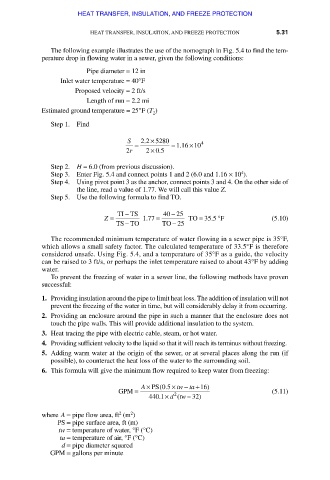
                          The following example illustrates the use of the nomograph in Fig. 5.4 to find the tem-
                        perature drop in flowing water in a sewer, given the following conditions:
                                   Pipe diameter = 12 in
                             Inlet water temperature = 40°F
                                Proposed velocity = 2 ft/s
                                   Length of run = 2.2 mi
                          Estimated ground temperature = 25°F (T )
                                                     2
                          Step 1.  Find

                                                    ×
                                              S   2 2 5280        4
                                                   .
                                                           116 10
                                                =         = .  ×
                                                    ×
                                               r 2  20 5 .
                          Step 2.  H = 6.0 (from previous discussion).
                                                                            4
                          Step 3.  Enter Fig. 5.4 and connect points 1 and 2 (6.0 and 1.16 × 10 ).
                          Step 4.   Using pivot point 3 as the anchor, connect points 3 and 4. On the other side of
                                 the line, read a value of 1.77. We will call this value Z.
                          Step 5.  Use the following formula to find TO.
                                                   .
                                        Z =  TI  − TS  177  =  40 − 25  TO  = 35 5.  °F  (5.10)
                                           TS  − TO    TO  − 25
                          The recommended minimum temperature of water flowing in a sewer pipe is 35°F,
                        which allows a small safety factor. The calculated temperature of 33.5°F is therefore
                        considered unsafe. Using Fig. 5.4, and a temperature of 35°F as a guide, the velocity
                        can be raised to 3 ft/s, or perhaps the inlet temperature raised to about 43°F by adding
                        water.
                          To prevent the freezing of water in a sewer line, the following methods have proven
                        successful:
                        1.  Providing insulation around the pipe to limit heat loss. The addition of insulation will not
                          prevent the freezing of the water in time, but will considerably delay it from occurring.
                        2.  Providing an enclosure around the pipe in such a manner that the enclosure does not
                          touch the pipe walls. This will provide additional insulation to the system.
                        3.  Heat tracing the pipe with electric cable, steam, or hot water.
                        4.  Providing sufficient velocity to the liquid so that it will reach its terminus without freezing.
                        5.  Adding warm water at the origin of the sewer, or at several places along the run (if
                          possible), to counteract the heat loss of the water to the surrounding soil.
                        6.  This formula will give the minimum flow required to keep water from freezing:
                                                                +
                                                             −
                                            GPM =  A  × PS(.05  × tw ta 16 )        (5.11)
                                                              −
                                                          2
                                                    440 .1 × dtw 32 )
                                                           (
                                            2
                                               2
                        where A = pipe flow area, ft  (m )
                            PS = pipe surface area, ft (m)
                            tw = temperature of water, °F (°C)
                            ta = temperature of air, °F (°C)
                             d = pipe diameter squared
                         GPM = gallons per minute
                     Downloaded from Digital Engineering Library @ McGraw-Hill (www.accessengineeringlibrary.com)
                                Copyright © 2009 The McGraw-Hill Companies. All rights reserved.
                                  Any use is subject to the Terms of Use as given at the website.

