


Page 353 - Facility Piping Systems Handbook for Industrial, Commercial, and Healthcare Facilities
P. 353
SITE UTILITY SYSTEMS

                                                SITE UTILITY SYSTEMS                 6.75


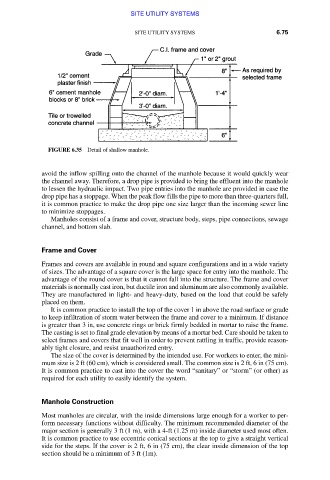
                         FIGURE 6.35  Detail of shallow manhole.


                        avoid the inflow spilling onto the channel of the manhole because it would quickly wear
                        the channel away. Therefore, a drop pipe is provided to bring the effluent into the manhole
                        to lessen the hydraulic impact. Two pipe entries into the manhole are provided in case the
                        drop pipe has a stoppage. When the peak flow fills the pipe to more than three-quarters full,
                        it is common practice to make the drop pipe one size larger than the incoming sewer line
                        to minimize stoppages.
                          Manholes consist of a frame and cover, structure body, steps, pipe connections, sewage
                        channel, and bottom slab.


                        Frame and Cover
                        Frames and covers are available in round and square configurations and in a wide variety
                        of sizes. The advantage of a square cover is the large space for entry into the manhole. The
                        advantage of the round cover is that it cannot fall into the structure. The frame and cover
                        materials is normally cast iron, but ductile iron and aluminum are also commonly available.
                        They are manufactured in light- and heavy-duty, based on the load that could be safely
                        placed on them.
                          It is common practice to install the top of the cover 1 in above the road surface or grade
                        to keep infiltration of storm water between the frame and cover to a minimum. If distance
                        is greater than 3 in, use concrete rings or brick firmly bedded in mortar to raise the frame.
                        The casting is set to final grade elevation by means of a mortar bed. Care should be taken to
                        select frames and covers that fit well in order to prevent rattling in traffic, provide reason-
                        ably tight closure, and resist unauthorized entry.
                          The size of the cover is determined by the intended use. For workers to enter, the mini-
                        mum size is 2 ft (60 cm), which is considered small. The common size is 2 ft, 6 in (75 cm).
                        It is common practice to cast into the cover the word “sanitary” or “storm” (or other) as
                        required for each utility to easily identify the system.


                        Manhole Construction
                        Most manholes are circular, with the inside dimensions large enough for a worker to per-
                        form necessary functions without difficulty. The minimum recommended diameter of the
                        major section is generally 3 ft (1 m), with a 4-ft (1.25 m) inside diameter used most often.
                        It is common practice to use eccentric conical sections at the top to give a straight vertical
                        side for the steps. If the cover is 2 ft, 6 in (75 cm), the clear inside dimension of the top
                        section should be a minimum of 3 ft (1m).


                     Downloaded from Digital Engineering Library @ McGraw-Hill (www.accessengineeringlibrary.com)
                                Copyright © 2009 The McGraw-Hill Companies. All rights reserved.
                                  Any use is subject to the Terms of Use as given at the website.

