


Page 355 - Facility Piping Systems Handbook for Industrial, Commercial, and Healthcare Facilities
P. 355
SITE UTILITY SYSTEMS

                                                SITE UTILITY SYSTEMS                 6.77

                        3.  Allowance for future
                        4.  Infiltration for long runs of piping
                        Peak Sanitary Discharge.  Peak sanitary discharge is calculated using fixture units in
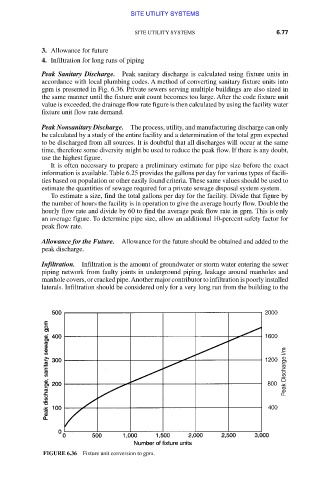
                        accordance with local plumbing codes. A method of converting sanitary fixture units into
                        gpm is presented in Fig. 6.36. Private sewers serving multiple buildings are also sized in
                        the same manner until the fixture unit count becomes too large. After the code fixture unit
                        value is exceeded, the drainage flow rate figure is then calculated by using the facility water
                        fixture unit flow rate demand.

                        Peak Nonsanitary Discharge.  The process, utility, and manufacturing discharge can only
                        be calculated by a study of the entire facility and a determination of the total gpm expected
                        to be discharged from all sources. It is doubtful that all discharges will occur at the same
                        time, therefore some diversity might be used to reduce the peak flow. If there is any doubt,
                        use the highest figure.
                          It is often necessary to prepare a preliminary estimate for pipe size before the exact
                        information is available. Table 6.25 provides the gallons per day for various types of facili-
                        ties based on population or other easily found criteria. These same values should be used to
                        estimate the quantities of sewage required for a private sewage disposal system system.
                          To estimate a size, find the total gallons per day for the facility. Divide that figure by
                        the number of hours the facility is in operation to give the average hourly flow. Double the
                        hourly flow rate and divide by 60 to find the average peak flow rate in gpm. This is only
                        an average figure. To determine pipe size, allow an additional 10-percent safety factor for
                        peak flow rate.
                        Allowance for the Future.  Allowance for the future should be obtained and added to the
                        peak discharge.
                        Infiltration.  Infiltration is the amount of groundwater or storm water entering the sewer
                        piping network from faulty joints in underground piping, leakage around manholes and
                        manhole covers, or cracked pipe. Another major contributor to infiltration is poorly installed
                        laterals. Infiltration should be considered only for a very long run from the building to the


                        FIGURE 6.36  Fixture unit conversion to gpm.


                     Downloaded from Digital Engineering Library @ McGraw-Hill (www.accessengineeringlibrary.com)
                                Copyright © 2009 The McGraw-Hill Companies. All rights reserved.
                                  Any use is subject to the Terms of Use as given at the website.

