


Page 358 - Facility Piping Systems Handbook for Industrial, Commercial, and Healthcare Facilities
P. 358
SITE UTILITY SYSTEMS

                      6.80                       CHAPTER SIX

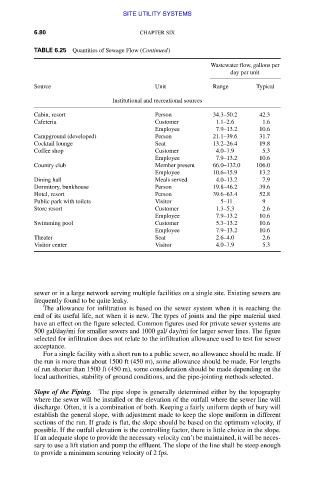
                      TABLE 6.25  Quantities of Sewage Flow (Continued )

                                                                                    Wastewater flow, gallons per
                                                                                                 day per unit
                      Source                         Unit            Range      Typical
                                          Institutional and recreational sources

                      Cabin, resort                  Person          34.3–50.2     42.3
                      Cafeteria                      Customer          1.1–2.6       1.6
                                                     Employee          7.9–13.2     10.6
                      Campground (developed)         Person          21.1–39.6     31.7
                      Cocktail lounge                Seat            13.2–26.4     19.8
                      Coffee shop                    Customer          4.0–7.9       5.3
                                                     Employee          7.9–13.2     10.6
                      Country club                   Member present   66.0–132.0   106.0
                                                     Employee        10.6–15.9     13.2
                      Dining hall                    Meals served      4.0–13.2       7.9
                      Dormitory, bunkhouse           Person          19.8–46.2     39.6
                      Hotel, resort                  Person          39.6–63.4     52.8
                      Public park with toilets       Visitor              5–11       9
                      Store resort                   Customer          1.3–5.3       2.6
                                                     Employee          7.9–13.2     10.6
                      Swimming pool                  Customer          5.3–13.2     10.6
                                                     Employee          7.9–13.2     10.6
                      Theater                        Seat              2.6–4.0       2.6
                      Visitor center                 Visitor           4.0–7.9       5.3


                      sewer or in a large network serving multiple facilities on a single site. Existing sewers are
                      frequently found to be quite leaky.
                        The allowance for infiltration is based on the sewer system when it is reaching the
                      end of its useful life, not when it is new. The types of joints and the pipe material used
                      have an effect on the figure selected. Common figures used for private sewer systems are
                      500 gal/day/mi for smaller sewers and 1000 gal/ day/mi for larger sewer lines. The figure
                      selected for infiltration does not relate to the infiltration allowance used to test for sewer
                      acceptance.
                        For a single facility with a short run to a public sewer, no allowance should be made. If
                      the run is more than about 1500 ft (450 m), some allowance should be made. For lengths
                      of run shorter than 1500 ft (450 m), some consideration should be made depending on the
                      local authorities, stability of ground conditions, and the pipe-jointing methods selected.
                      Slope of the Piping.  The pipe slope is generally determined either by the topography
                      where the sewer will be installed or the elevation of the outfall where the sewer line will
                      discharge. Often, it is a combination of both. Keeping a fairly uniform depth of bury will
                      establish the general slope, with adjustment made to keep the slope uniform in different
                      sections of the run. If grade is flat, the slope should be based on the optimum velocity, if
                      possible. If the outfall elevation is the controlling factor, there is little choice in the slope.
                      If an adequate slope to provide the necessary velocity can’t be maintained, it will be neces-
                      sary to use a lift station and pump the effluent. The slope of the line shall be steep enough
                      to provide a minimum scouring velocity of 2 fps.


                   Downloaded from Digital Engineering Library @ McGraw-Hill (www.accessengineeringlibrary.com)
                              Copyright © 2009 The McGraw-Hill Companies. All rights reserved.
                                Any use is subject to the Terms of Use as given at the website.

