


Page 243 - Fair, Geyer, and Okun's Water and wastewater engineering : water supply and wastewater removal
P. 243
JWCL344_ch06_194-229.qxd  8/2/10  9:51 PM  Page 204


                    204  Chapter 6  Water Distribution Systems: Components, Design, and Operation
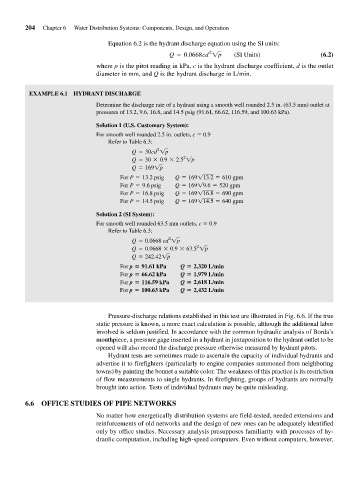
                                             Equation 6.2 is the hydrant discharge equation using the SI units:
                                                                            2
                                                                Q = 0.0668cd 1p   (SI Units)                  (6.2)
                                         where p is the pitot reading in kPa, c is the hydrant discharge coefficient, d is the outlet
                                         diameter in mm, and Q is the hydrant discharge in L/min.


                     EXAMPLE 6.1   HYDRANT DISCHARGE
                                         Determine the discharge rate of a hydrant using a smooth well rounded 2.5 in. (63.5 mm) outlet at
                                         pressures of 13.2, 9.6, 16.8, and 14.5 psig (91.61, 66.62, 116.59, and 100.63 kPa).
                                         Solution 1 (U.S. Customary System):
                                         For smooth well rounded 2.5 in. outlets, c   0.9
                                             Refer to Table 6.3:
                                                            2
                                                      Q = 30cd 1p
                                                                    2
                                                      Q = 30 * 0.9 * 2.5 1p
                                                      Q = 1691p
                                                  For P = 13.2 psig    Q = 169113.2 = 610 gpm
                                                  For P = 9.6 psig    Q = 16919.6 = 520 gpm
                                                  For P = 16.8 psig    Q = 169116.8 = 690 gpm
                                                  For P = 14.5 psig    Q = 169114.5 = 640 gpm

                                         Solution 2 (SI System):
                                         For smooth well rounded 63.5 mm outlets, c   0.9
                                             Refer to Table 6.3:
                                                               2
                                                      Q = 0.0668 cd 1p
                                                                        2
                                                      Q = 0.0668 * 0.9 * 63.5 1p
                                                      Q = 242.421p
                                                  For p   91.61 kPa    Q   2,320 L/min
                                                  For p   66.62 kPa    Q   1,979 L/min
                                                  For p   116.59 kPa    Q   2,618 L/min
                                                  For p   100.63 kPa    Q   2,432 L/min


                                             Pressure-discharge relations established in this test are illustrated in Fig. 6.6. If the true
                                         static pressure is known, a more exact calculation is possible, although the additional labor
                                         involved is seldom justified. In accordance with the common hydraulic analysis of Borda’s
                                         mouthpiece, a pressure gage inserted in a hydrant in juxtaposition to the hydrant outlet to be
                                         opened will also record the discharge pressure otherwise measured by hydrant pitots.
                                             Hydrant tests are sometimes made to ascertain the capacity of individual hydrants and
                                         advertise it to firefighters (particularly to engine companies summoned from neighboring
                                         towns) by painting the bonnet a suitable color. The weakness of this practice is its restriction
                                         of flow measurements to single hydrants. In firefighting, groups of hydrants are normally
                                         brought into action. Tests of individual hydrants may be quite misleading.

                    6.6  OFFICE STUDIES OF PIPE NETWORKS
                                         No matter how energetically distribution systems are field-tested, needed extensions and
                                         reinforcements of old networks and the design of new ones can be adequately identified
                                         only by office studies. Necessary analysis presupposes familiarity with processes of hy-
                                         draulic computation, including high-speed computers. Even without computers, however,

