


Page 549 - Fair, Geyer, and Okun's Water and wastewater engineering : water supply and wastewater removal
P. 549
JWCL344_ch14_500-554.qxd  8/7/10  8:56 PM  Page 507


                                                                                     14.3 Collection of Stormwaters  507


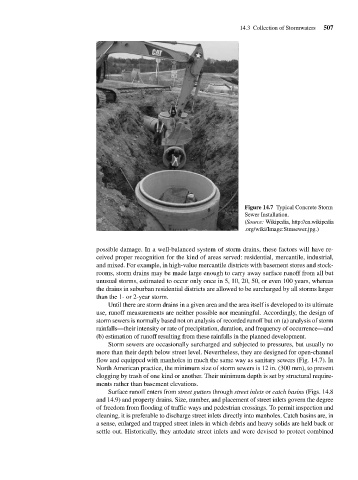
                                                                                       Figure 14.7 Typical Concrete Storm
                                                                                       Sewer Installation.
                                                                                       (Source: Wikipedia, http://en.wikipedia
                                                                                       .org/wiki/Image:Stmsewer.jpg.)


                                         possible damage. In a well-balanced system of storm drains, these factors will have re-
                                         ceived proper recognition for the kind of areas served: residential, mercantile, industrial,
                                         and mixed. For example, in high-value mercantile districts with basement stores and stock-
                                         rooms, storm drains may be made large enough to carry away surface runoff from all but
                                         unusual storms, estimated to occur only once in 5, 10, 20, 50, or even 100 years, whereas
                                         the drains in suburban residential districts are allowed to be surcharged by all storms larger
                                         than the 1- or 2-year storm.
                                             Until there are storm drains in a given area and the area itself is developed to its ultimate
                                         use, runoff measurements are neither possible nor meaningful. Accordingly, the design of
                                         storm sewers is normally based not on analysis of recorded runoff but on (a) analysis of storm
                                         rainfalls—their intensity or rate of precipitation, duration, and frequency of occurrence—and
                                         (b) estimation of runoff resulting from these rainfalls in the planned development.
                                             Storm sewers are occasionally surcharged and subjected to pressures, but usually no
                                         more than their depth below street level. Nevertheless, they are designed for open-channel
                                         flow and equipped with manholes in much the same way as sanitary sewers (Fig. 14.7). In
                                         North American practice, the minimum size of storm sewers is 12 in. (300 mm), to prevent
                                         clogging by trash of one kind or another. Their minimum depth is set by structural require-
                                         ments rather than basement elevations.
                                             Surface runoff enters from street gutters through street inlets or catch basins (Figs. 14.8
                                          and 14.9) and property drains. Size, number, and placement of street inlets govern the degree
                                          of freedom from flooding of traffic ways and pedestrian crossings. To permit inspection and
                                          cleaning, it is preferable to discharge street inlets directly into manholes. Catch basins are, in
                                          a sense, enlarged and trapped street inlets in which debris and heavy solids are held back or
                                          settle out. Historically, they antedate street inlets and were devised to protect combined

