


Page 585 - Fair, Geyer, and Okun's Water and wastewater engineering : water supply and wastewater removal
P. 585
JWCL344_ch14_500-554.qxd  8/7/10  8:56 PM  Page 541


                                                                                 14.16 Safety and Hazards Prevention  541


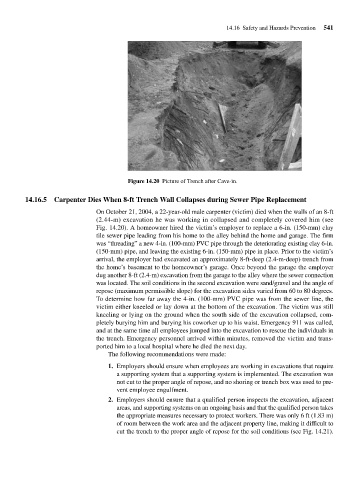
                                                   Figure 14.20 Picture of Trench after Cave-in.

                    14.16.5 Carpenter Dies When 8-ft Trench Wall Collapses during Sewer Pipe Replacement
                                         On October 21, 2004, a 22-year-old male carpenter (victim) died when the walls of an 8-ft
                                         (2.44-m) excavation he was working in collapsed and completely covered him (see
                                         Fig. 14.20). A homeowner hired the victim’s employer to replace a 6-in. (150-mm) clay
                                         tile sewer pipe leading from his home to the alley behind the home and garage. The firm
                                         was “threading” a new 4-in. (100-mm) PVC pipe through the deteriorating existing clay 6-in.
                                         (150-mm) pipe, and leaving the existing 6-in. (150-mm) pipe in place. Prior to the victim’s
                                         arrival, the employer had excavated an approximately 8-ft-deep (2.4-m-deep) trench from
                                         the home’s basement to the homeowner’s garage. Once beyond the garage the employer
                                         dug another 8-ft (2.4-m) excavation from the garage to the alley where the sewer connection
                                         was located. The soil conditions in the second excavation were sand/gravel and the angle of
                                         repose (maximum permissible slope) for the excavation sides varied from 60 to 80 degrees.
                                         To determine how far away the 4-in. (100-mm) PVC pipe was from the sewer line, the
                                         victim either kneeled or lay down at the bottom of the excavation. The victim was still
                                         kneeling or lying on the ground when the south side of the excavation collapsed, com-
                                         pletely burying him and burying his coworker up to his waist. Emergency 911 was called,
                                         and at the same time all employees jumped into the excavation to rescue the individuals in
                                         the trench. Emergency personnel arrived within minutes, removed the victim and trans-
                                         ported him to a local hospital where he died the next day.
                                             The following recommendations were made:

                                             1. Employers should ensure when employees are working in excavations that require
                                                a supporting system that a supporting system is implemented. The excavation was
                                                not cut to the proper angle of repose, and no shoring or trench box was used to pre-
                                                vent employee engulfment.
                                             2. Employers should ensure that a qualified person inspects the excavation, adjacent
                                                areas, and supporting systems on an ongoing basis and that the qualified person takes
                                                the appropriate measures necessary to protect workers. There was only 6 ft (1.83 m)
                                                of room between the work area and the adjacent property line, making it difficult to
                                                cut the trench to the proper angle of repose for the soil conditions (see Fig. 14.21).

