


Page 589 - Fair, Geyer, and Okun's Water and wastewater engineering : water supply and wastewater removal
P. 589
JWCL344_ch14_500-554.qxd  8/7/10  8:56 PM  Page 545


                                                                                              Problems/Questions  545
                                             4. Workers were permitted to enter an untested atmosphere of a confined space.
                                                The atmosphere should have been tested by a qualified person prior to entry by
                                                workers.
                                             5. Both fatal victims lacked experience in working in confined spaces. If workers are
                                                expected, as part of their job, to work in confined spaces, they should be given ap-
                                                propriate training.
                                             6. The established corporate safety procedures for work in confined spaces were not
                                                implemented. Management, including local supervisors, should comply with ap-
                                                proved corporate policy and procedures for confined space entry as well as other
                                                rules and regulations approved by the corporate president. The policy and proce-
                                                dure should include entry into confined spaces for rescue efforts.
                                             7. Workers were not able to adequately assess their risk of personal injury of the tasks
                                                they were required to perform, much less the additional hazards associated with
                                                rescue efforts. Management should develop a safe job procedure for all routine
                                                tasks starting with high-risk tasks and specifically establish a policy and procedure
                                                regarding rescue efforts.


                    PROBLEMS/QUESTIONS
                    14.1  An inverted siphon is to carry a minimum dry-weather  maximum flow there will be no backing up of sewage
                             3                              3
                    flow of 3.0 ft /s, a maximum dry-weather flow of 8.0 ft /s, and  into lateral B?
                                        3
                    a wet weather flow of 130 ft /s in three pipes. Select the proper  (c) At a further point downstream, a two-pipe inverted
                    diameters to ensure velocities of 3.0 ft/s in pipes carrying  siphon is to be used to cross a valley. One pipe is to
                    wastewater and 5.0 ft/s in pipes carrying stormwater.  handle the minimum flow and the second is to carry
                    14.2  An inverted siphon is to carry a minimum dry-weather  the remaining flow at maximum flow condition.
                    flow of 85 L/s, a maximum dry-weather flow of 226 L/s, and a  Determine the required diameters of the two pipes.
                    wet weather flow of 3,680 L/s in three pipes. Select the proper  14.4  Part of an existing trunk sewer ABC has a diameter of
                    diameters to ensure velocities of 0.9 m/s in pipes carrying  600 mm (see Fig. 14.24). The length of sewers between succes-
                    wastewater and 1.5 m/s in pipes carrying stormwater.  sive manholes A to B and B to C is 50 m. The following exist-
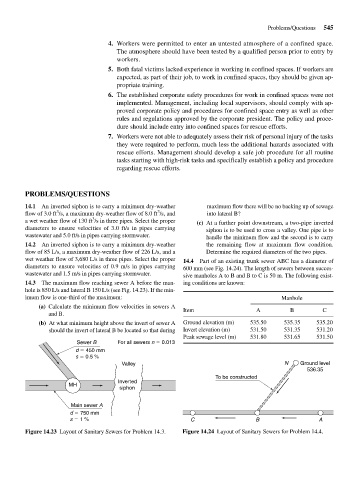
                    14.3  The maximum flow reaching sewer A before the man-  ing conditions are known:
                    hole is 850 L/s and lateral B 150 L/s (see Fig. 14.23). If the min-
                    imum flow is one-third of the maximum:                                        Manhole
                        (a) Calculate the minimum flow velocities in sewers A
                                                                    Item                  A         B         C
                           and B.
                        (b) At what minimum height above the invert of sewer A  Ground elevation (m)  535.50  535.35  535.20
                           should the invert of lateral B be located so that during  Invert elevation (m)  531.50  531.35  531.20
                                                                    Peak sewage level (m)  531.80  531.65   531.50
                                    Sewer B     For all sewers n   0.013
                                   d   450 mm
                                   s   0.5 %
                                                 Valley                                            N   Ground level
                                                                                                         536.35
                                                                              To be constructed
                                                Inverted
                                 MH
                                                 siphon
                                  Main sewer A
                                  d   750 mm
                                  s   1 %                             C                   B                  A
                    Figure 14.23 Layout of Sanitary Sewers for Problem 14.3.  Figure 14.24 Layout of Sanitary Sewers for Problem 14.4.

