


Page 590 - Fair, Geyer, and Okun's Water and wastewater engineering : water supply and wastewater removal
P. 590
JWCL344_ch14_500-554.qxd  8/7/10  8:56 PM  Page 546


                    546  Chapter 14  Design of Sewer Systems
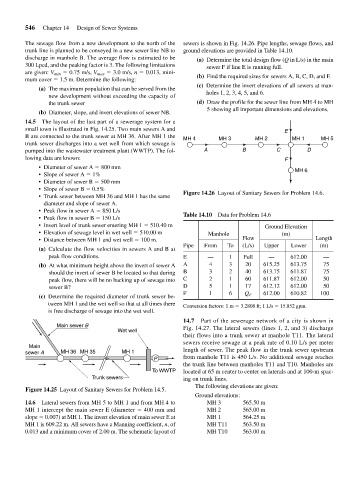
                    The sewage flow from a new development to the north of the  sewers is shown in Fig. 14.26. Pipe lengths, sewage flows, and
                    trunk line is planned to be conveyed in a new sewer line NB to  ground elevations are provided in Table 14.10.
                    discharge in manhole B. The average flow is estimated to be  (a) Determine the total design flow (Q in L/s) in the main
                    300 Lpcd, and the peaking factor is 3. The following limitations  sewer F if line E is running full.
                    are given: V min   0.75 m/s, V max   3.0 m/s, n   0.013, mini-
                    mum cover   1.5 m. Determine the following:         (b) Find the required sizes for sewers A, B, C, D, and F.
                                                                        (c) Determine the invert elevations of all sewers at man-
                        (a) The maximum population that can be served from the
                           new development without exceeding the capacity of  holes 1, 2, 3, 4, 5, and 6.
                           the trunk sewer                              (d) Draw the profile for the sewer line from MH 4 to MH
                                                                           5 showing all important dimensions and elevations.
                        (b) Diameter, slope, and invert elevations of sewer NB.
                    14.5  The layout of the last part of a sewerage system for a
                    small town is illustrated in Fig. 14.25. Two main sewers A and                 E
                    B are connected to the trunk sewer at MH 36. After MH 1 the  MH 4  MH 3  MH 2    MH 1     MH 5
                    trunk sewer discharges into a wet well from which sewage is
                    pumped into the wastewater treatment plant (WWTP). The fol-  A    B         C         D
                    lowing data are known:                                                         F
                        • Diameter of sewer A   800 mm                                                MH 6
                        • Slope of sewer A   1%
                        • Diameter of sewer B   500 mm
                        • Slope of sewer B   0.5%
                        • Trunk sewer between MH 36 and MH 1 has the same  Figure 14.26 Layout of Sanitary Sewers for Problem 14.6.
                          diameter and slope of sewer A.
                        • Peak flow in sewer A   850 L/s
                        • Peak flow in sewer B   150 L/s            Table 14.10 Data for Problem 14.6
                        • Invert level of trunk sewer entering MH 1   510.40 m               Ground Elevation
                        • Elevation of sewage level in wet well   510.00 m  Manhole               (m)
                        • Distance between MH 1 and wet well   100 m.                 Flow                  Length
                                                                    Pipe  From   To   (L/s)  Upper   Lower   (m)
                        (a) Calculate the flow velocities in sewers A and B at
                           peak flow conditions.                    E      —      1   Full    —     612.00    —
                        (b) At what minimum height above the invert of sewer A  A  4  3  20  615.25  613.75   75
                           should the invert of sewer B be located so that during  B  3  2  40  613.75  611.87  75
                           peak flow, there will be no backing up of sewage into  C  2  1  60  611.87  612.00  50
                           sewer B?                                 D       5     1    17   612.12  612.00    50
                                                                    F       1     6    Q F  612.00  610.82    100
                        (c) Determine the required diameter of trunk sewer be-
                           tween MH 1 and the wet well so that at all times there  Conversion factors: 1 m   3.2808 ft; 1 L/s   15.852 gpm.
                           is free discharge of sewage into the wet well.
                                                                    14.7  Part of the sewerage network of a city is shown in
                             Main sewer B
                                                Wet well            Fig. 14.27. The lateral sewers (lines 1, 2, and 3) discharge
                                                                    their flows into a trunk sewer at manhole T11. The lateral
                                                                    sewers receive sewage at a peak rate of 0.10 L/s per meter
                     Main
                    sewer A    MH 36 MH 35       MH 1               length of sewer. The peak flow in the trunk sewer upstream
                                                           P        from manhole T11 is 450 L/s. No additional sewage reaches
                                                                    the trunk line between manholes T11 and T10. Manholes are
                                                           To WWTP  located at 65 m center to center on laterals and at 100-m spac-
                                        Trunk sewers                ing on trunk lines.
                                                                        The following elevations are given:
                    Figure 14.25 Layout of Sanitary Sewers for Problem 14.5.
                                                                        Ground elevations:
                    14.6  Lateral sewers from MH 5 to MH 1 and from MH 4 to  MH 3     565.50 m
                    MH 1 intercept the main sewer E (diameter   400 mm and  MH 2      565.00 m
                    slope   0.007) at MH 1. The invert elevation of main sewer E at  MH 1  564.25 m
                    MH 1 is 609.22 m. All sewers have a Manning coefficient, n, of  MH T11  563.50 m
                    0.013 and a minimum cover of 2.00 m. The schematic layout of  MH T10  563.00 m

