


Page 586 - Fair, Geyer, and Okun's Water and wastewater engineering : water supply and wastewater removal
P. 586
JWCL344_ch14_500-554.qxd  8/7/10  8:56 PM  Page 542


                    542  Chapter 14  Design of Sewer Systems


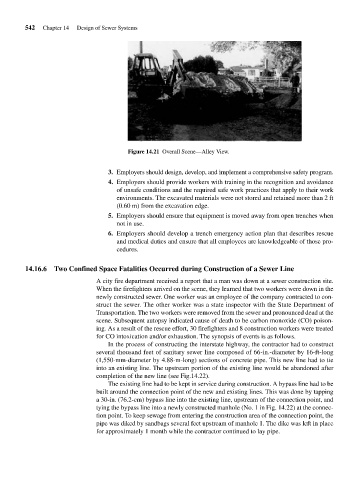
                                                   Figure 14.21 Overall Scene—Alley View.


                                             3. Employers should design, develop, and implement a comprehensive safety program.
                                             4. Employers should provide workers with training in the recognition and avoidance
                                                of unsafe conditions and the required safe work practices that apply to their work
                                                environments. The excavated materials were not stored and retained more than 2 ft
                                                (0.60 m) from the excavation edge.
                                             5. Employers should ensure that equipment is moved away from open trenches when
                                                not in use.
                                             6. Employers should develop a trench emergency action plan that describes rescue
                                                and medical duties and ensure that all employees are knowledgeable of those pro-
                                                cedures.

                    14.16.6 Two Confined Space Fatalities Occurred during Construction of a Sewer Line

                                         A city fire department received a report that a man was down at a sewer construction site.
                                         When the firefighters arrived on the scene, they learned that two workers were down in the
                                         newly constructed sewer. One worker was an employee of the company contracted to con-
                                         struct the sewer. The other worker was a state inspector with the State Department of
                                         Transportation. The two workers were removed from the sewer and pronounced dead at the
                                         scene. Subsequent autopsy indicated cause of death to be carbon monoxide (CO) poison-
                                         ing. As a result of the rescue effort, 30 firefighters and 8 construction workers were treated
                                         for CO intoxication and/or exhaustion. The synopsis of events is as follows.
                                             In the process of constructing the interstate highway, the contractor had to construct
                                         several thousand feet of sanitary sewer line composed of 66-in.-diameter by 16-ft-long
                                         (1,550-mm-diameter by 4.88-m-long) sections of concrete pipe. This new line had to tie
                                         into an existing line. The upstream portion of the existing line would be abandoned after
                                         completion of the new line (see Fig.14.22).
                                             The existing line had to be kept in service during construction. A bypass line had to be
                                         built around the connection point of the new and existing lines. This was done by tapping
                                         a 30-in. (76.2-cm) bypass line into the existing line, upstream of the connection point, and
                                         tying the bypass line into a newly constructed manhole (No. 1 in Fig. 14.22) at the connec-
                                         tion point. To keep sewage from entering the construction area of the connection point, the
                                         pipe was diked by sandbags several feet upstream of manhole 1. The dike was left in place
                                         for approximately 1 month while the contractor continued to lay pipe.

