


Page 186 - Fiber Fracture
P. 186
FRACTURE OF CARBON FIBERS                                            171

           described by  Fain et al. (1988) and Robinson and Edie (1996). However, the stiffness
           aspects  of  modified  fiber  cross-section  could  be  adversely  affected  while  thermal
           and adhesion responses may be improved. Packing densities of individual fibers in fiber
           assemblages may also be changed. Processing continuity and part fabrication costs could
           be critical aspects influencing adoption of this technology to modify product responses.
           A more detailed discussion of fiber manufacture will be found in Bahl et al. (1998).
             Commercially  useful  fibers  are  made  from  mesophase  pitch  at  heat  treatment
           temperatures of  1600°C and above. As heat treatment temperatures are increased, the
           modulus of mesophase pitch fibers increases, and modulus values close to the theoretical
           modulus of graphite (1 TPa) are possible. The term ‘graphitization’ is frequently applied
           to  heat  treatment  above 2500°C.  However, this  does  not  mean  that  the  structure is
           converted to graphite. Most carbon fibers, even those with a modulus above 700 GPa,
           are mostly made of  turbostratic carbon with small graphitic domains. The inert gases
           used in carbonizing furnaces are nitrogen and argon. Nitrogen is preferred because of
           cost. However, above about 2000°C significant quantities of cyanogens are produced by
           the reaction of nitrogen with the graphite of the furnace, so argon, which is completely
           inert, is sometimes used instead.


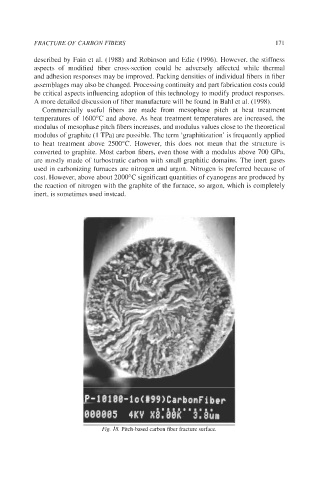
                              Fig.  18. Pitch-based  carbon fiber fracture surface.

