


Page 229 - Fiber Fracture
P. 229
H.U. Kunzi


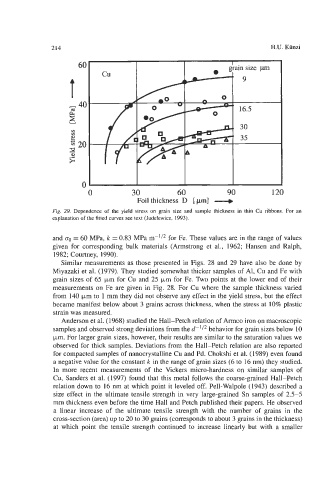
                          0            30           60            90           120
                                        Foil thickness  D  [ pm]
                Fig. 29.  Dependence of  the  yield  stress on grain  size  and  sample thickness in  thin  Cu  ribbons.  For  an
                explanation of the fitted curves see text (Judelewicz, 1993).


                and oo = 60 MPa, k = 0.83 MPa m-’12  for Fe. These values are in the range of values
                given for corresponding bulk  materials (Armstrong et  al.,  1962; Hansen and  Ralph,
                1982; Courtney, 1990).
                   Similar measurements as those presented in Figs. 28 and 29 have also be done by
                Miyazaki et al. (1979). They studied somewhat thicker samples of  Al, Cu and Fe with
                grain sizes of 65  pm for Cu  and 25 prn for Fe. Two points at the lower end of their
                measurements on Fe are given in  Fig.  28. For Cu where the sample thickness varied
                from 140 wm to 1 mm they did not observe any effect in the yield stress, but the effect
                became manifest below about 3 grains across thickness, when the stress at 10% plastic
                strain was measured.
                   Anderson et al. (1968) studied the Hall-Petch  relation of Armco iron on macroscopic
                samples and observed strong deviations from the d-’12 behavior for grain sizes below 10
                Fm. For larger grain sizes, however, their results are similar to the saturation values we
                observed for thick samples. Deviations from the Hall-Petch  relation are also reported
                for compacted samples of nanocrystalline Cu and Pd. Chokshi et al. (1989) even found
                a negative value for the constant k in the range of grain sizes (6 to 16 nm) they studied.
                In  more  recent  measurements of  the  Vickers micro-hardness on  similar  samples of
                Cu, Sanders et al. (1997) found that this metal follows the coarse-grained Hall-Petch
                relation down to  I6 nm  at which point it leveled off. Pell-Walpole (I 943) described a
                size effect in the ultimate tensile strength in  very  large-grained Sn samples of  2.5-5
                mm thickness even before the time Hall and Petch published their papers. He observed
                a  linear  increase  of  the  ultimate  tensile  strength  with  the  number  of  grains  in  the
                cross-section (area) up to 20 to 30 grains (corresponds to about 3 grains in the thickness)
                at  which  point  the tensile strength continued to  increase linearly but  with  a  smaller

