


Page 297 - Fluid Mechanics and Thermodynamics of Turbomachinery
P. 297
278 Fluid Mechanics, Thermodynamics of Turbomachinery
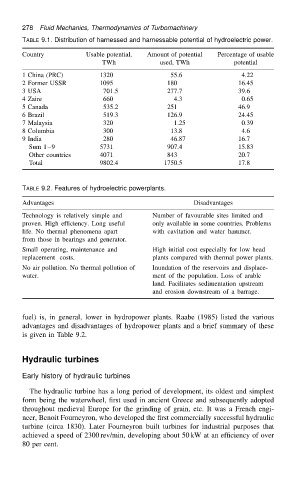
                          TABLE 9.1. Distribution of harnessed and harnessable potential of hydroelectric power.

                          Country          Usable potential,  Amount of potential  Percentage of usable
                                                TWh             used, TWh           potential
                          1 China (PRC)        1320                55.6               4.22
                          2 Former USSR        1095               180                16.45
                          3 USA                 701.5             277.7              39.6
                          4 Zaire               660                 4.3               0.65
                          5 Canada              535.2             251                46.9
                          6 Brazil              519.3             126.9              24.45
                          7 Malaysia            320                 1.25              0.39
                          8 Columbia            300                13.8               4.6
                          9 India               280                46.87             16.7
                            Sum 1 9            5731               907.4              15.83
                            Other countries    4071               843                20.7
                            Total              9802.4            1750.5              17.8


                          TABLE 9.2. Features of hydroelectric powerplants.
                          Advantages                                     Disadvantages
                          Technology is relatively simple and  Number of favourable sites limited and
                          proven. High efficiency. Long useful  only available in some countries. Problems
                          life. No thermal phenomena apart    with cavitation and water hammer.
                          from those in bearings and generator.
                          Small operating, maintenance and    High initial cost especially for low head
                          replacement costs.                  plants compared with thermal power plants.
                          No air pollution. No thermal pollution of  Inundation of the reservoirs and displace-
                          water.                              ment of the population. Loss of arable
                                                              land. Facilitates sedimentation upstream
                                                              and erosion downstream of a barrage.


                          fuel) is, in general, lower in hydropower plants. Raabe (1985) listed the various
                          advantages and disadvantages of hydropower plants and a brief summary of these
                          is given in Table 9.2.


                          Hydraulic turbines

                          Early history of hydraulic turbines
                            The hydraulic turbine has a long period of development, its oldest and simplest
                          form being the waterwheel, first used in ancient Greece and subsequently adopted
                          throughout medieval Europe for the grinding of grain, etc. It was a French engi-
                          neer, Benoit Fourneyron, who developed the first commercially successful hydraulic
                          turbine (circa 1830). Later Fourneyron built turbines for industrial purposes that
                          achieved a speed of 2300 rev/min, developing about 50 kW at an efficiency of over
                          80 per cent.

