Page 302 - Fluid Mechanics and Thermodynamics of Turbomachinery
P. 302
Hydraulic Turbines  283


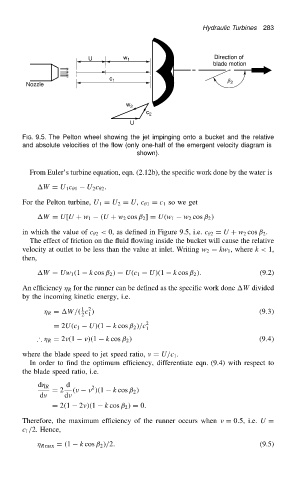
                                            U         w 1                      Direction of
                                                                              blade motion

                                                  c 1                             b
                           Nozzle                                                  2

                                                      w 2
                                                            c 2
                                                        U

                          FIG. 9.5. The Pelton wheel showing the jet impinging onto a bucket and the relative
                          and absolute velocities of the flow (only one-half of the emergent velocity diagram is
                                                         shown).

                            From Euler’s turbine equation, eqn. (2.12b), the specific work done by the water is
                                            U 2 c  2 .
                              W D U 1 c  1
                          For the Pelton turbine, U 1 D U 2 D U, c  1 D c 1 so we get
                                                                      w 2 cos ˇ 2 /
                              W D U[U C w 1   .U C w 2 cos ˇ 2 ] D U.w 1
                          in which the value of c  2 < 0, as defined in Figure 9.5, i.e. c  2 D U C w 2 cos ˇ 2 .
                            The effect of friction on the fluid flowing inside the bucket will cause the relative
                          velocity at outlet to be less than the value at inlet. Writing w 2 D kw 1 , where k< 1,
                          then,
                              W D Uw 1 .1  k cos ˇ 2 / D U.c 1  U/.1  k cos ˇ 2 /.        (9.2)

                          An efficiency   R for the runner can be defined as the specific work done W divided
                          by the incoming kinetic energy, i.e.
                                          1 2
                                  R D W/. c /                                             .9.3/
                                          2 1
                                  D 2U.c 1  U/.1   k cos ˇ 2 //c 1 2
                              ∴   R D 2 .1   /.1  k cos ˇ 2 /                              .9.4/
                          where the blade speed to jet speed ratio,   D U/c 1 .
                            In order to find the optimum efficiency, differentiate eqn. (9.4) with respect to
                          the blade speed ratio, i.e.

                              d  R    d      2
                                  D 2   .     /.1  k cos ˇ 2 /
                               d     d
                                  D 2.1   2 /.1  k cos ˇ 2 / D 0.

                          Therefore, the maximum efficiency of the runner occurs when   D 0.5, i.e. U D
                          c 1 /2. Hence,

                                R max D .1  k cos ˇ 2 //2.                                 (9.5)
   297   298   299   300   301   302   303   304   305   306   307