


Page 298 - Fluid Mechanics and Thermodynamics of Turbomachinery
P. 298
Hydraulic Turbines  279
                            The American engineer James B. Francis designed the first radial-inflow hydraulic
                          turbine which became widely used, gave excellent results and was highly regarded.
                          In its original form it was used for heads of between 10 and 100 m. A simplified
                          form of this turbine is shown in Figure 1.1d. It will be observed that the flow path
                          followed is essentially from a radial direction to an axial direction.
                            The Pelton wheel turbine, named after its American inventor Lester A. Pelton, was
                          brought into use in the second half of the nineteenth century. This is an impulse
                          turbine in which water is piped at high pressure to a nozzle where it expands
                          completely to atmospheric pressure. The emerging jet impacts onto the blades (or
                          buckets) of the turbine producing the required torque and power output. A simplified
                          diagram of a Pelton wheel turbine is shown in Figure 1.1f. The head of water used
                          originally was between about 90 m and 900 m (modern versions operate up to heads
                          of 2000 m).
                            The increasing need for more power during the early years of the twentieth century
                          also led to the invention of a turbine suitable for small heads of water, i.e. 3 m to
                          9 m, in river locations where a dam could be built. It was in 1913 that Viktor Kaplan
                          revealed his idea of the propeller (or Kaplan) turbine, see Figure 1.1e, which acts
                          like a ship’s propeller but in reverse At a later date Kaplan improved his turbine
                          by means of swivelable blades which improved the efficiency of the turbine in
                          accordance with the prevailing conditions (i.e. the available flow rate and head).

                          Flow regimes for maximum efficiency

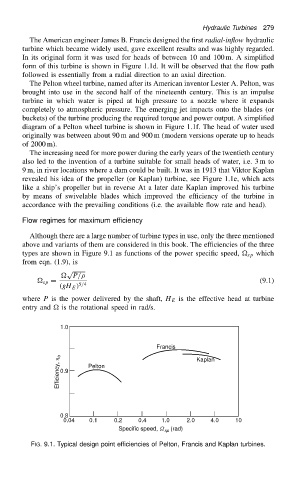
                            Although there are a large number of turbine types in use, only the three mentioned
                          above and variants of them are considered in this book. The efficiencies of the three
                          types are shown in Figure 9.1 as functions of the power specific speed,  sp which
                          from eqn. (1.9), is
                                      p
                                     P/
                               sp D                                                       (9.1)
                                    .gH E / 5/4
                          where P is the power delivered by the shaft, H E is the effective head at turbine
                          entry and  is the rotational speed in rad/s.


                                    1.0

                                                               Francis    Kaplan
                                    Efficiency, h o  0.9  Pelton


                                    0.8
                                     0.04   0.1    0.2    0.4   1.0    2.0    4.0    10
                                                    Specific speed, W  (rad)
                                                                 sp
                            FIG. 9.1. Typical design point efficiencies of Pelton, Francis and Kaplan turbines.

