


Page 294 - Fluid Mechanics and Thermodynamics of Turbomachinery
P. 294
Radial Flow Gas Turbines  275
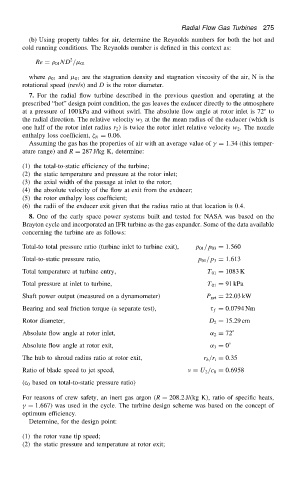
                            (b) Using property tables for air, determine the Reynolds numbers for both the hot and
                          cold running conditions. The Reynolds number is defined in this context as:
                                       2
                              Re D   01 ND /  01
                            where   01 and   01 are the stagnation density and stagnation viscosity of the air, N is the
                          rotational speed (rev/s) and D is the rotor diameter.
                            7. For the radial flow turbine described in the previous question and operating at the
                          prescribed “hot” design point condition, the gas leaves the exducer directly to the atmosphere
                          at a pressure of 100 kPa and without swirl. The absolute flow angle at rotor inlet is 72 ° to
                          the radial direction. The relative velocity w 3 at the the mean radius of the exducer (which is
                          one half of the rotor inlet radius r 2 ) is twice the rotor inlet relative velocity w 2 . The nozzle
                          enthalpy loss coefficient,   N D 0.06.
                            Assuming the gas has the properties of air with an average value of
 D 1.34 (this temper-
                          ature range) and R D 287 J/kg K, determine:

                          (1) the total-to-static efficiency of the turbine;
                          (2) the static temperature and pressure at the rotor inlet;
                          (3) the axial width of the passage at inlet to the rotor;
                          (4) the absolute velocity of the flow at exit from the exducer;
                          (5) the rotor enthalpy loss coefficient;
                          (6) the radii of the exducer exit given that the radius ratio at that location is 0.4.
                            8. One of the early space power systems built and tested for NASA was based on the
                          Brayton cycle and incorporated an IFR turbine as the gas expander. Some of the data available
                          concerning the turbine are as follows:

                          Total-to total pressure ratio (turbine inlet to turbine exit),  p 01 /p 03 D 1.560
                          Total-to-static pressure ratio,                 p 01 /p 3 D 1.613
                          Total temperature at turbine entry,                T 01 D 1083 K
                          Total pressure at inlet to turbine,                T 01 D 91 kPa
                          Shaft power output (measured on a dynamometer)     P net D 22.03 kW
                          Bearing and seal friction torque (a separate test),    f D 0.0794 Nm
                          Rotor diameter,                                    D 2 D 15.29 cm
                          Absolute flow angle at rotor inlet,                  ˛ 2 D 72 °

                          Absolute flow angle at rotor exit,                   ˛ 3 D 0 °
                          The hub to shroud radius ratio at rotor exit,     r h /r t D 0.35
                          Ratio of blade speed to jet speed,             D U 2 /c 0 D 0.6958
                          (c 0 based on total-to-static pressure ratio)

                          For reasons of crew safety, an inert gas argon (R D 208.2 J/(kg K), ratio of specific heats,

 D 1.667) was used in the cycle. The turbine design scheme was based on the concept of
                          optimum efficiency.
                            Determine, for the design point:
                          (1) the rotor vane tip speed;
                          (2) the static pressure and temperature at rotor exit;

