


Page 289 - Fluid Mechanics and Thermodynamics of Turbomachinery
P. 289
270 Fluid Mechanics, Thermodynamics of Turbomachinery

                          the absolute exit velocity c 3 reaches the speed of sound. It is also assumed that c 3
                          is without swirl and that the fluid is a perfect gas.
                            For simplicity it is also assumed that the diffuser efficiency is 100% so that,
                          referring to Figure 8.4, T 04ss D T 03ss .p 03 D p 04 /. Thus, the turbine total-to-total
                          efficiency is,

                                   T 01  T 03
                                t D         .                                             (8.51)
                                   T 01  T 03ss
                          The expression for the spouting velocity, now becomes

                               2
                              c D 2C p .T 01  T 03ss /,
                               0
                          is substituted into eqn. (8.51) to give,
                                        1         2C p T 03
                                t D                      .                                (8.52)
                                   1  .T 03ss /T 01 /  c 0 2
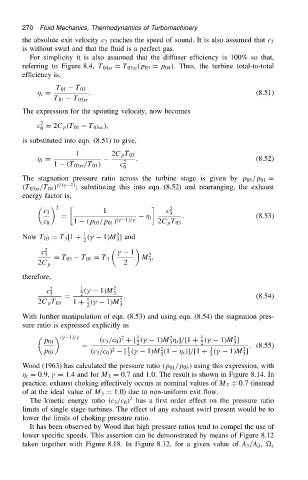
                          The stagnation pressure ratio across the turbine stage is given by p 03 /p 01 D
                          .T 03ss /T 01 /
/.
 1/ ; substituting this into eqn. (8.52) and rearranging, the exhaust
                          energy factor is,
                                   2                              2

                                c 3             1                 c 3
                                     D              .
 1//
    t      .                   (8.53)
                                c 0     1   .p 03 /p 01 /      2C p T 03
                                           1        2
                          Now T 03 D T 3 [1 C .
  1/M ] and
                                           2        3
                               c 2
   1
                                3                            2
                                   D T 03  T 01 D T 3      M ,
                                                             3
                              2C p                    2
                          therefore,
                                 c 2      1 .
  1/M 2
                                 3        2        3
                                     D      1        2  .                                 (8.54)
                                        1 C .
   1/M
                              2C p T 03
                                            2        3
                          With further manipulation of eqn. (8.53) and using eqn. (8.54) the stagnation pres-
                          sure ratio is expressed explicitly as
                                    .
 1//
          2   1        2        1        2

                                p 01           .c 3 /c 0 / C [ .
  1/M   t ]/[1 C .
  1/M ]
                                                                                    3
                                                                  3
                                                                           2
                                                         2
                                          D            1                      1         . (8.55)
                                                                2
                                                                                       2
                                p 03         .c 3 /c 0 / 2  [ .
  1/M .1    t /]/[1 C .
  1/M ]
                                                       2        3            2         3
                          Wood (1963) has calculated the pressure ratio .p 01 /p 03 / using this expression, with
                            t D 0.9,
 D 1.4 and for M 3 D 0.7 and 1.0. The result is shown in Figure 8.14. In
                          practice, exhaust choking effectively occurs at nominal values of M 3 + 0.7 (instead
                          of at the ideal value of M 3 D 1.0) due to non-uniform exit flow.
                                                       2
                            The kinetic energy ratio .c 3 /c 0 / has a first order effect on the pressure ratio
                          limits of single stage turbines. The effect of any exhaust swirl present would be to
                          lower the limits of choking pressure ratio.
                            It has been observed by Wood that high pressure ratios tend to compel the use of
                          lower specific speeds. This assertion can be demonstrated by means of Figure 8.12
                          taken together with Figure 8.18. In Figure 8.12, for a given value of A 3 /A d ,  s

