


Page 286 - Fluid Mechanics and Thermodynamics of Turbomachinery
P. 286
Radial Flow Gas Turbines  267


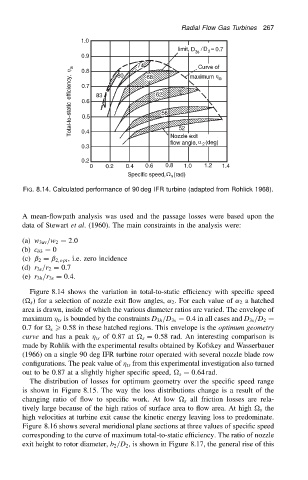
                          FIG. 8.14. Calculated performance of 90 deg IFR turbine (adapted from Rohlick 1968).


                          A mean-flowpath analysis was used and the passage losses were based upon the
                          data of Stewart et al. (1960). The main constraints in the analysis were:

                          (a) w 3av /w 2 D 2.0
                          (b) c  3 D 0
                          (c) ˇ 2 D ˇ 2,opt , i.e. zero incidence
                          (d) r 3s /r 2 D 0.7
                          (e) r 3h /r 3s D 0.4.
                            Figure 8.14 shows the variation in total-to-static efficiency with specific speed
                          ( s ) for a selection of nozzle exit flow angles, ˛ 2 . For each value of ˛ 2 a hatched
                          area is drawn, inside of which the various diameter ratios are varied. The envelope of
                          maximum   ts is bounded by the constraints D 3h /D 3s D 0.4 in all cases and D 3s /D 2 D
                          0.7 for  s > 0.58 in these hatched regions. This envelope is the optimum geometry
                          curve and has a peak   ts of 0.87 at  s D 0.58 rad. An interesting comparison is
                          made by Rohlik with the experimental results obtained by Kofskey and Wasserbauer
                          (1966) on a single 90 deg IFR turbine rotor operated with several nozzle blade row
                          configurations. The peak value of   ts from this experimental investigation also turned
                          out to be 0.87 at a slightly higher specific speed,  s D 0.64 rad.
                            The distribution of losses for optimum geometry over the specific speed range
                          is shown in Figure 8.15. The way the loss distributions change is a result of the
                          changing ratio of flow to specific work. At low  s all friction losses are rela-
                          tively large because of the high ratios of surface area to flow area. At high  s the
                          high velocities at turbine exit cause the kinetic energy leaving loss to predominate.
                          Figure 8.16 shows several meridional plane sections at three values of specific speed
                          corresponding to the curve of maximum total-to-static efficiency. The ratio of nozzle
                          exit height to rotor diameter, b 2 /D 2 , is shown in Figure 8.17, the general rise of this

