


Page 282 - Fluid Mechanics and Thermodynamics of Turbomachinery
P. 282
Radial Flow Gas Turbines 263
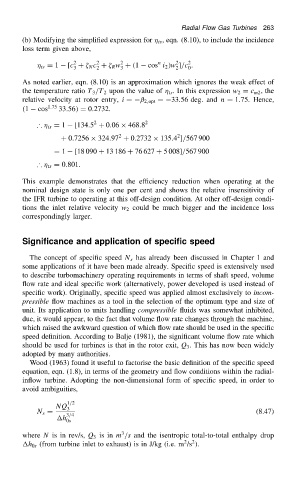
(b) Modifying the simplified expression for ts , eqn. (8.10), to include the incidence
loss term given above,
2
2
2
2
2
n
ts D 1 [c C N c C R w C .1 cos i 2 /w ]/c .
2
2
0
3
3
As noted earlier, eqn. (8.10) is an approximation which ignores the weak effect of
the temperature ratio T 3 /T 2 upon the value of ts . In this expression w 2 D c m2 , the
relative velocity at rotor entry, i Dˇ 2,opt D33.56 deg. and n D 1.75. Hence,
.1 cos 1.75 33.56/ D 0.2732.
2
∴ ts D 1 [134.5 C 0.06 ð 468.8 2
2
2
C 0.7256 ð 324.97 C 0.2732 ð 135.4 ]/567 900
D 1 [18 090 C 13 186 C 76 627 C 5 008]/567 900
∴ ts D 0.801.
This example demonstrates that the efficiency reduction when operating at the
nominal design state is only one per cent and shows the relative insensitivity of
the IFR turbine to operating at this off-design condition. At other off-design condi-
tions the inlet relative velocity w 2 could be much bigger and the incidence loss
correspondingly larger.
Significance and application of specific speed
The concept of specific speed N s has already been discussed in Chapter 1 and
some applications of it have been made already. Specific speed is extensively used
to describe turbomachinery operating requirements in terms of shaft speed, volume
flow rate and ideal specific work (alternatively, power developed is used instead of
specific work). Originally, specific speed was applied almost exclusively to incom-
pressible flow machines as a tool in the selection of the optimum type and size of
unit. Its application to units handling compressible fluids was somewhat inhibited,
due, it would appear, to the fact that volume flow rate changes through the machine,
which raised the awkward question of which flow rate should be used in the specific
speed definition. According to Balje (1981), the significant volume flow rate which
should be used for turbines is that in the rotor exit, Q 3 . This has now been widely
adopted by many authorities.
Wood (1963) found it useful to factorise the basic definition of the specific speed
equation, eqn. (1.8), in terms of the geometry and flow conditions within the radial-
inflow turbine. Adopting the non-dimensional form of specific speed, in order to
avoid ambiguities,
1/2
NQ 3
N s D 3/4 (8.47)
h
0s
3
where N is in rev/s, Q 3 is in m /s and the isentropic total-to-total enthalpy drop
2
2
h 0s (from turbine inlet to exhaust) is in J/kg (i.e. m /s ).

