


Page 279 - Fluid Mechanics and Thermodynamics of Turbomachinery
P. 279
260 Fluid Mechanics, Thermodynamics of Turbomachinery
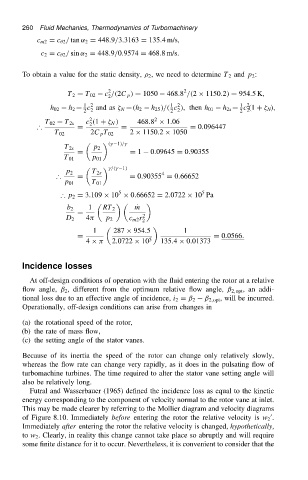
                              c m2 D c  2 / tan ˛ 2 D 448.9/3.3163 D 135.4 m/s,
                               c 2 D c  2 / sin ˛ 2 D 448.9/0.9574 D 468.8 m/s.


                          To obtain a value for the static density,   2 , we need to determine T 2 and p 2 :

                                                 2
                                                                      2
                                      T 2 D T 02  c /.2C p / D 1050  468.8 /.2 ð 1150.2/ D 954.5K,
                                                 2
                                           1 2                     1 2                1 2
                                  h 02  h 2 D c and as   N D.h 2  h 25 //. c /, then h 01  h 2s D c .1 C   N /,
                                           2 2                     2 2                2 2
                                            2
                                                              2
                                           c .1 C   N /   468.8 ð 1.06
                                T 02
                              ∴          D  2        D                  D 0.096447
                                     T 2s
                                   T 02      2C p T 02  2 ð 1150.2 ð 1050

                                                  .
 1//
                                     T 2s    p 2
                                         D             D 1   0.09645 D 0.90355
                                     T 01    p 01

/.
 1/
                                   ∴  p 2  D  T 2s     D 0.90355 D 0.66652
                                                                4
                                     p 01    T 01
                                                                           5
                                                    5
                                    ∴ p 2 D 3.109 ð 10 ð 0.66652 D 2.0722 ð 10 Pa

                                      b 2   1   RT 2     P m
                                         D                 2
                                      D 2  4     p 2   c m2 r 2

                                             1     287 ð 954.5        1
                                         D                                     D 0.0566.
                                           4 ð     2.0722 ð 10 5  135.4 ð 0.01373
                          Incidence losses
                            At off-design conditions of operation with the fluid entering the rotor at a relative
                          flow angle, ˇ 2 , different from the optimum relative flow angle, ˇ 2,opt , an addi-
                          tional loss due to an effective angle of incidence, i 2 D ˇ 2  ˇ 2,opt , will be incurred.
                          Operationally, off-design conditions can arise from changes in
                          (a) the rotational speed of the rotor,
                          (b) the rate of mass flow,
                          (c) the setting angle of the stator vanes.
                          Because of its inertia the speed of the rotor can change only relatively slowly,
                          whereas the flow rate can change very rapidly, as it does in the pulsating flow of
                          turbomachine turbines. The time required to alter the stator vane setting angle will
                          also be relatively long.
                            Futral and Wasserbauer (1965) defined the incidence loss as equal to the kinetic
                          energy corresponding to the component of velocity normal to the rotor vane at inlet.
                          This may be made clearer by referring to the Mollier diagram and velocity diagrams
                                                                                              0
                          of Figure 8.10. Immediately before entering the rotor the relative velocity is w 2 .
                          Immediately after entering the rotor the relative velocity is changed, hypothetically,
                          to w 2 . Clearly, in reality this change cannot take place so abruptly and will require
                          some finite distance for it to occur. Nevertheless, it is convenient to consider that the

