


Page 275 - Fluid Mechanics and Thermodynamics of Turbomachinery
P. 275
256 Fluid Mechanics, Thermodynamics of Turbomachinery
                            30


                           Number of rotor vanes, Z  20  Jamieson eqn.  Glassman eqn.  Whitfield eqn.


                            10


                                           60                        70                      80
                                                   Absolute flow angle, a  (deg)
                                                                   2
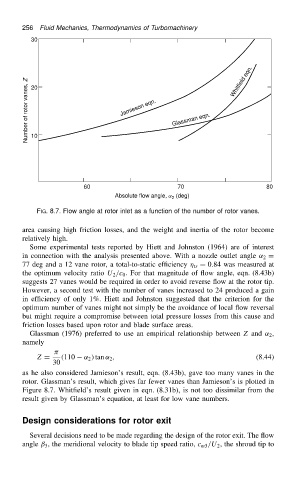
                              FIG. 8.7. Flow angle at rotor inlet as a function of the number of rotor vanes.

                          area causing high friction losses, and the weight and inertia of the rotor become
                          relatively high.
                            Some experimental tests reported by Hiett and Johnston (1964) are of interest
                          in connection with the analysis presented above. With a nozzle outlet angle ˛ 2 D
                          77 deg and a 12 vane rotor, a total-to-static efficiency   ts D 0.84 was measured at
                          the optimum velocity ratio U 2 /c 0 . For that magnitude of flow angle, eqn. (8.43b)
                          suggests 27 vanes would be required in order to avoid reverse flow at the rotor tip.
                          However, a second test with the number of vanes increased to 24 produced a gain
                          in efficiency of only 1%. Hiett and Johnston suggested that the criterion for the
                          optimum number of vanes might not simply be the avoidance of local flow reversal
                          but might require a compromise between total pressure losses from this cause and
                          friction losses based upon rotor and blade surface areas.
                            Glassman (1976) preferred to use an empirical relationship between Z and ˛ 2 ,
                          namely

                              Z D   .110   ˛ 2 / tan ˛ 2 ,                                (8.44)
                                  30
                          as he also considered Jamieson’s result, eqn. (8.43b), gave too many vanes in the
                          rotor. Glassman’s result, which gives far fewer vanes than Jamieson’s is plotted in
                          Figure 8.7. Whitfield’s result given in eqn. (8.31b), is not too dissimilar from the
                          result given by Glassman’s equation, at least for low vane numbers.

                          Design considerations for rotor exit

                            Several decisions need to be made regarding the design of the rotor exit. The flow
                          angle ˇ 3 , the meridional velocity to blade tip speed ratio, c m3 /U 2 , the shroud tip to

