


Page 273 - Fluid Mechanics and Thermodynamics of Turbomachinery
P. 273
254 Fluid Mechanics, Thermodynamics of Turbomachinery


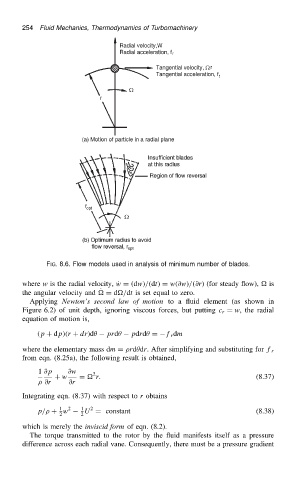
                                FIG. 8.6. Flow models used in analysis of minimum number of blades.

                          where w is the radial velocity, Pw D .dw//.dt/ D w.∂w//.∂r/ (for steady flow),  is
                                               P
                          the angular velocity and  D d/dt is set equal to zero.
                            Applying Newton’s second law of motion to a fluid element (as shown in
                          Figure 6.2) of unit depth, ignoring viscous forces, but putting c r D w, the radial
                          equation of motion is,

                              .p C dp/.r C dr/d   prd   pdrd  Df r dm

                          where the elementary mass dm D  rd dr. After simplifying and substituting for f r
                          from eqn. (8.25a), the following result is obtained,
                              1 ∂p    ∂w     2
                                   C w    D  r.                                          (8.37)
                                ∂r     ∂r
                          Integrating eqn. (8.37) with respect to r obtains

                                             2
                                    1
                              p/  C w 2   1 U D constant                                  (8.38)
                                    2     2
                          which is merely the inviscid form of eqn. (8.2).
                            The torque transmitted to the rotor by the fluid manifests itself as a pressure
                          difference across each radial vane. Consequently, there must be a pressure gradient

