


Page 268 - Fluid Mechanics and Thermodynamics of Turbomachinery
P. 268
Radial Flow Gas Turbines  249


                                                  P       S  P      S


                                                        Direction
                                                        of rotation
                                                          (a)

                                                             a 2
                                                                                 b 2


                                                      c 2
                                                                               w 2


                                                            U 2
                                                           (b)

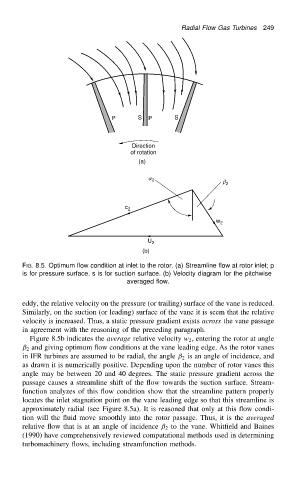
                          FIG. 8.5. Optimum flow condition at inlet to the rotor. (a) Streamline flow at rotor inlet; p
                          is for pressure surface, s is for suction surface. (b) Velocity diagram for the pitchwise
                                                       averaged flow.

                          eddy, the relative velocity on the pressure (or trailing) surface of the vane is reduced.
                          Similarly, on the suction (or leading) surface of the vane it is seem that the relative
                          velocity is increased. Thus, a static pressure gradient exists across the vane passage
                          in agreement with the reasoning of the preceding paragraph.
                            Figure 8.5b indicates the average relative velocity w 2 , entering the rotor at angle
                          ˇ 2 and giving optimum flow conditions at the vane leading edge. As the rotor vanes
                          in IFR turbines are assumed to be radial, the angle ˇ 2 is an angle of incidence, and
                          as drawn it is numerically positive. Depending upon the number of rotor vanes this
                          angle may be between 20 and 40 degrees. The static pressure gradient across the
                          passage causes a streamline shift of the flow towards the suction surface. Stream-
                          function analyzes of this flow condition show that the streamline pattern properly
                          locates the inlet stagnation point on the vane leading edge so that this streamline is
                          approximately radial (see Figure 8.5a). It is reasoned that only at this flow condi-
                          tion will the fluid move smoothly into the rotor passage. Thus, it is the averaged
                          relative flow that is at an angle of incidence ˇ 2 to the vane. Whitfield and Baines
                          (1990) have comprehensively reviewed computational methods used in determining
                          turbomachinery flows, including streamfunction methods.

