


Page 264 - Fluid Mechanics and Thermodynamics of Turbomachinery
P. 264
Radial Flow Gas Turbines 245
p
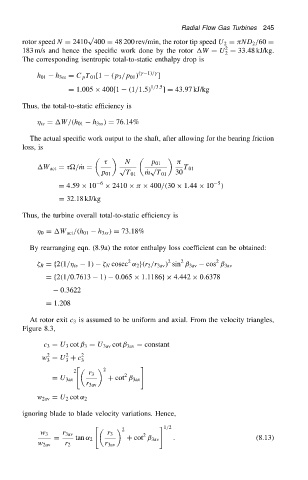
rotor speed N D 2410 400 D 48 200 rev/min, the rotor tip speed U 2 D ND 2 /60 D
2
183 m/s and hence the specific work done by the rotor W D U D 33.48 kJ/kg.
2
The corresponding isentropic total-to-static enthalpy drop is
h 01 h 3ss D C p T 01 [1 .p 3 /p 01 / .
1//
]
D 1.005 ð 400[1 .1/1.5/ 1/3.5 ] D 43.97 kJ/kg
Thus, the total-to-static efficiency is
ts D W/.h 01 h 3ss / D 76.14%
The actual specific work output to the shaft, after allowing for the bearing friction
loss, is
N p 01
W act D / Pm D p p T 01
p 01 T 01 P m T 01 30
5
D 4.59 ð 10 6 ð 2410 ð ð 400/.30 ð 1.44 ð 10 /
D 32.18 kJ/kg
Thus, the turbine overall total-to-static efficiency is
0 D W act /.h 01 h 3ss / D 73.18%
By rearranging eqn. (8.9a) the rotor enthalpy loss coefficient can be obtained:
2
2
2
2
R Df2.1/ ts 1/ N cosec ˛ 2 g.r 2 /r 3av / sin ˇ 3av cos ˇ 3av
Df2.1/0.7613 1/ 0.065 ð 1.1186gð 4.442 ð 0.6378
0.3622
D 1.208
At rotor exit c 3 is assumed to be uniform and axial. From the velocity triangles,
Figure 8.3,
c 3 D U 3 cot ˇ 3 D U 3av cot ˇ 3av D constant
2
2
w D U C c 2
3 3 3
" #
2 2
r 3
2
D U 3av C cot ˇ 3av
r 3av
w 2av D U 2 cot ˛ 2
ignoring blade to blade velocity variations. Hence,
" # 1/2
2
w 3 r 3av r 3 2
D tan ˛ 2 C cot ˇ 3av . (8.13)
w 2av r 2 r 3av

