


Page 261 - Fluid Mechanics and Thermodynamics of Turbomachinery
P. 261
242 Fluid Mechanics, Thermodynamics of Turbomachinery
Spouting velocity
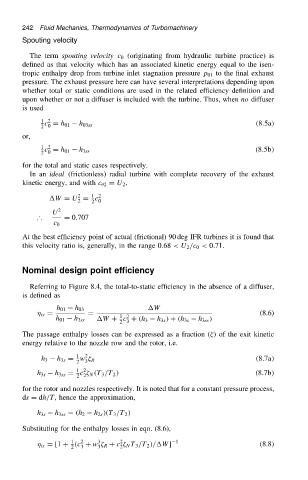
The term spouting velocity c 0 (originating from hydraulic turbine practice) is
defined as that velocity which has an associated kinetic energy equal to the isen-
tropic enthalpy drop from turbine inlet stagnation pressure p 01 to the final exhaust
pressure. The exhaust pressure here can have several interpretations depending upon
whether total or static conditions are used in the related efficiency definition and
upon whether or not a diffuser is included with the turbine. Thus, when no diffuser
is used
1 2
c D h 01
2 0 h 03ss .8.5a/
or,
1 2 .8.5b/
c D h 01
2 0 h 3ss
for the total and static cases respectively.
In an ideal (frictionless) radial turbine with complete recovery of the exhaust
kinetic energy, and with c 2 D U 2 ,
2 1 2
W D U D c
2
2 0
U 2
∴ D 0.707
c 0
At the best efficiency point of actual (frictional) 90 deg IFR turbines it is found that
this velocity ratio is, generally, in the range 0.68 <U 2 /c 0 < 0.71.
Nominal design point efficiency
Referring to Figure 8.4, the total-to-static efficiency in the absence of a diffuser,
is defined as
h 01 h 03 W
ts D D (8.6)
1 2
h 01 h 3ss W C c C .h 3 h 3s / C .h 3s h 3ss /
2 3
The passage enthalpy losses can be expressed as a fraction ( ) of the exit kinetic
energy relative to the nozzle row and the rotor, i.e.
1 2
h 3 h 3s D w R .8.7a/
3
2
1 2
h 3ss D c N .T 3 /T 2 / .8.7b/
h 3s
2 2
for the rotor and nozzles respectively. It is noted that for a constant pressure process,
ds D dh/T, hence the approximation,
h 2s /.T 3 /T 2 /
h 3s h 3ss D .h 2
Substituting for the enthalpy losses in eqn. (8.6),
2
3
1
2
ts D [1 C .c C w R C c N T 3 /T 2 //W] 1 (8.8)
2 3 3 2

