


Page 256 - Fluid Mechanics and Thermodynamics of Turbomachinery
P. 256
Radial Flow Gas Turbines  237


                                                                                         .2/
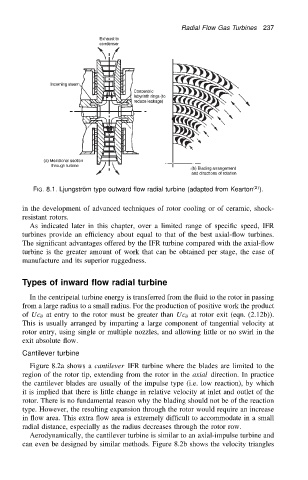
                             FIG. 8.1. Ljungstr¨ om type outward flow radial turbine (adapted from Kearton ).
                          in the development of advanced techniques of rotor cooling or of ceramic, shock-
                          resistant rotors.
                            As indicated later in this chapter, over a limited range of specific speed, IFR
                          turbines provide an efficiency about equal to that of the best axial-flow turbines.
                          The significant advantages offered by the IFR turbine compared with the axial-flow
                          turbine is the greater amount of work that can be obtained per stage, the ease of
                          manufacture and its superior ruggedness.


                          Types of inward flow radial turbine
                            In the centripetal turbine energy is transferred from the fluid to the rotor in passing
                          from a large radius to a small radius. For the production of positive work the product
                          of Uc   at entry to the rotor must be greater than Uc   at rotor exit (eqn. (2.12b)).
                          This is usually arranged by imparting a large component of tangential velocity at
                          rotor entry, using single or multiple nozzles, and allowing little or no swirl in the
                          exit absolute flow.
                          Cantilever turbine
                            Figure 8.2a shows a cantilever IFR turbine where the blades are limited to the
                          region of the rotor tip, extending from the rotor in the axial direction. In practice
                          the cantilever blades are usually of the impulse type (i.e. low reaction), by which
                          it is implied that there is little change in relative velocity at inlet and outlet of the
                          rotor. There is no fundamental reason why the blading should not be of the reaction
                          type. However, the resulting expansion through the rotor would require an increase
                          in flow area. This extra flow area is extremely difficult to accommodate in a small
                          radial distance, especially as the radius decreases through the rotor row.
                            Aerodynamically, the cantilever turbine is similar to an axial-impulse turbine and
                          can even be designed by similar methods. Figure 8.2b shows the velocity triangles

