


Page 263 - Fluid Mechanics and Thermodynamics of Turbomachinery
P. 263
244 Fluid Mechanics, Thermodynamics of Turbomachinery
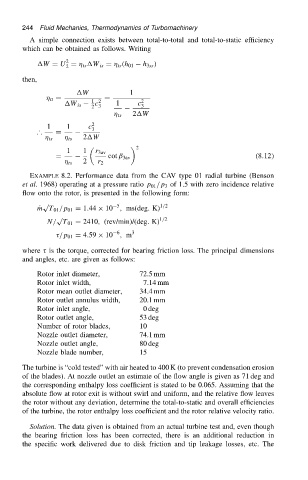
A simple connection exists between total-to-total and total-to-static efficiency
which can be obtained as follows. Writing
2
W D U D ts W is D ts .h 01 h 3ss /
2
then,
W 1
tt D D
1 2 2
W is c 1 c 3
2 3
2W
ts
1 1 c 2
∴ D 3
ts ts 2W
2
1 1 r 3av
D cot ˇ 3av .8.12/
ts 2 r 2
EXAMPLE 8.2. Performance data from the CAV type 01 radial turbine (Benson
et al. 1968) operating at a pressure ratio p 01 /p 3 of 1.5 with zero incidence relative
flow onto the rotor, is presented in the following form:
p 5 1/2
P m T 01 /p 01 D 1.44 ð 10 , ms(deg. K)
p 1/2
N/ T 01 D 2410, (rev/min)/(deg. K)
6
/p 01 D 4.59 ð 10 , m 3
where is the torque, corrected for bearing friction loss. The principal dimensions
and angles, etc. are given as follows:
Rotor inlet diameter, 72.5 mm
Rotor inlet width, 7.14 mm
Rotor mean outlet diameter, 34.4 mm
Rotor outlet annulus width, 20.1 mm
Rotor inlet angle, 0 deg
Rotor outlet angle, 53 deg
Number of rotor blades, 10
Nozzle outlet diameter, 74.1 mm
Nozzle outlet angle, 80 deg
Nozzle blade number, 15
The turbine is “cold tested” with air heated to 400 K (to prevent condensation erosion
of the blades). At nozzle outlet an estimate of the flow angle is given as 71 deg and
the corresponding enthalpy loss coefficient is stated to be 0.065. Assuming that the
absolute flow at rotor exit is without swirl and uniform, and the relative flow leaves
the rotor without any deviation, determine the total-to-static and overall efficiencies
of the turbine, the rotor enthalpy loss coefficient and the rotor relative velocity ratio.
Solution. The data given is obtained from an actual turbine test and, even though
the bearing friction loss has been corrected, there is an additional reduction in
the specific work delivered due to disk friction and tip leakage losses, etc. The

