


Page 267 - Fluid Mechanics and Thermodynamics of Turbomachinery
P. 267
248 Fluid Mechanics, Thermodynamics of Turbomachinery
                          Practical values of   N for well-designed nozzle rows in normal operation are usually
                          in the range 0.90 6   N 6 0.97.
                          (ii) Rotor loss coefficients

                            At either the design condition (Figure 8.4), or at the off-design condition dealt
                          with later (Figure 8.5), the rotor passage friction losses can be expressed in terms
                          of the following coefficients.
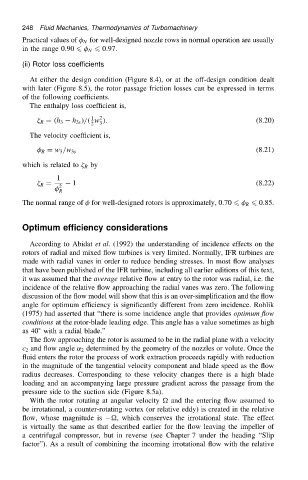
                            The enthalpy loss coefficient is,

                                               2
                                             1
                                R D .h 3  h 3s //. w /.                                   (8.20)
                                               3
                                             2
                            The velocity coefficient is,
                                                                                          (8.21)
                                R D w 3 /w 3s
                          which is related to   R by
                                   1
                                R D     1                                                 (8.22)
                                     2
                                    R
                          The normal range of   for well-designed rotors is approximately, 0.70 6   R 6 0.85.


                          Optimum efficiency considerations

                            According to Abidat et al. (1992) the understanding of incidence effects on the
                          rotors of radial and mixed flow turbines is very limited. Normally, IFR turbines are
                          made with radial vanes in order to reduce bending stresses. In most flow analyses
                          that have been published of the IFR turbine, including all earlier editions of this text,
                          it was assumed that the average relative flow at entry to the rotor was radial, i.e. the
                          incidence of the relative flow approaching the radial vanes was zero. The following
                          discussion of the flow model will show that this is an over-simplification and the flow
                          angle for optimum efficiency is significantly different from zero incidence. Rohlik
                          (1975) had asserted that “there is some incidence angle that provides optimum flow
                          conditions at the rotor-blade leading edge. This angle has a value sometimes as high
                          as 40 ° with a radial blade.”
                            The flow approaching the rotor is assumed to be in the radial plane with a velocity
                          c 2 and flow angle ˛ 2 determined by the geometry of the nozzles or volute. Once the
                          fluid enters the rotor the process of work extraction proceeds rapidly with reduction
                          in the magnitude of the tangential velocity component and blade speed as the flow
                          radius decreases. Corresponding to these velocity changes there is a high blade
                          loading and an accompanying large pressure gradient across the passage from the
                          pressure side to the suction side (Figure 8.5a).
                            With the rotor rotating at angular velocity  and the entering flow assumed to
                          be irrotational, a counter-rotating vortex (or relative eddy) is created in the relative
                          flow, whose magnitude is  , which conserves the irrotational state. The effect
                          is virtually the same as that described earlier for the flow leaving the impeller of
                          a centrifugal compressor, but in reverse (see Chapter 7 under the heading “Slip
                          factor”). As a result of combining the incoming irrotational flow with the relative

