


Page 269 - Fluid Mechanics and Thermodynamics of Turbomachinery
P. 269
250 Fluid Mechanics, Thermodynamics of Turbomachinery
Wilson and Jansen (1965) appear to have been the first to note that the optimum
angle of incidence was virtually identical to the angle of “slip” of the flow leaving
the impeller of a radially bladed centrifugal compressor with the same number of
vanes as the turbine rotor. Following Whitfield and Baines (1990), an incidence
factor, , is defined, analogous to the slip factor used in centrifugal compressors:
D c 2 /U 2 .
The slip factor most often used in determining the flow angle at rotor inlet is that
devised by Stanitz (1952) for radial vaned impellers, so for the incidence factor
D 1 0.63 /Z ³ 1 2/Z. (7.18a)
Thus, from the geometry of Figure 8.5b, we obtain
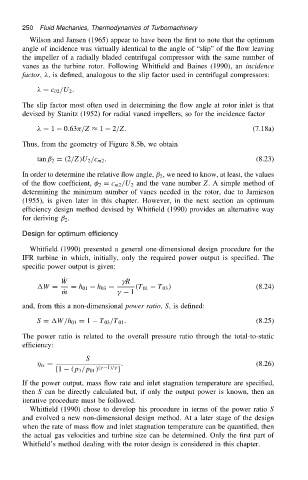
tan ˇ 2 D .2/Z/U 2 /c m2 . (8.23)
In order to determine the relative flow angle, ˇ 2 , we need to know, at least, the values
of the flow coefficient, 2 D c m2 /U 2 and the vane number Z. A simple method of
determining the minimum number of vanes needed in the rotor, due to Jamieson
(1955), is given later in this chapter. However, in the next section an optimum
efficiency design method devised by Whitfield (1990) provides an alternative way
for deriving ˇ 2 .
Design for optimum efficiency
Whitfield (1990) presented a general one-dimensional design procedure for the
IFR turbine in which, initially, only the required power output is specified. The
specific power output is given:
P W
R
W D D h 01 h 03 D .T 01 T 03 / (8.24)
P m
1
and, from this a non-dimensional power ratio, S, is defined:
S D W/h 01 D 1 T 03 /T 01 . (8.25)
The power ratio is related to the overall pressure ratio through the total-to-static
efficiency:
S
ts D . (8.26)
[1 .p 3 /p 01 / .
1//
]
If the power output, mass flow rate and inlet stagnation temperature are specified,
then S can be directly calculated but, if only the output power is known, then an
iterative procedure must be followed.
Whitfield (1990) chose to develop his procedure in terms of the power ratio S
and evolved a new non-dimensional design method. At a later stage of the design
when the rate of mass flow and inlet stagnation temperature can be quantified, then
the actual gas velocities and turbine size can be determined. Only the first part of
Whitfield’s method dealing with the rotor design is considered in this chapter.

